
Alternatives to Expensive Bathroom Suites 2026
Table of Contents
- Why 2026 Bathroom Trends Favour Refreshing Over Replacing
- Bathroom Wall Panels vs Tiles Cost: The Real Difference
- Alternative 1: Refit Walls with Large-Format Panels
- Alternative 2: Upgrade Fixtures and Fittings Only
- Alternative 3: Mix New Sanitaryware with Existing Pieces
- Budget Bathroom Renovation Ideas That Cut Labour Costs
- Small Bathroom Design Hacks 2026: Maximise Impact
- Conclusion
- Frequently Asked Questions
Last Updated: September 9, 2026
The cost of a full bathroom suite replacement often runs into four figures before a single tile is fixed, which is why many UK homeowners are now searching for alternatives to expensive bathroom suites 2026 that deliver the same visual impact. The smartest approach is refreshing what you have rather than ripping everything out.
Why 2026 Bathroom Trends Favour Refreshing Over Replacing
The biggest driver behind this shift is simple: the cost of labour. Tiling, plastering, and plumbing a full suite can easily double your materials budget.
The focus in 2026 is on uncluttered, minimalist spaces where the wall finish does the heavy lifting, not the porcelain.
Bathroom Wall Panels vs Tiles Cost: The Real Difference
When you compare bathroom wall panels vs tiles cost, the gap is significant once installation is factored in. Tiles require a tradesperson for cutting, adhesive, grouting, and sealing.
A tongue and groove system clicks together and fixes directly to the wall, eliminating grout lines entirely and removing the most common place for mould to build up.
Alternative 1: Refit Walls with Large-Format Panels
The single most effective way to transform a dated bathroom without replacing the suite is to refit the walls with large-format panels. A product like the Decorwall Maxi Panels-Beige Marble 2400mm x 900mm x 10mm at £54.00 per panel covers roughly 2.16m² of wall, meaning three or four panels can resurface an entire shower enclosure for well under £250.

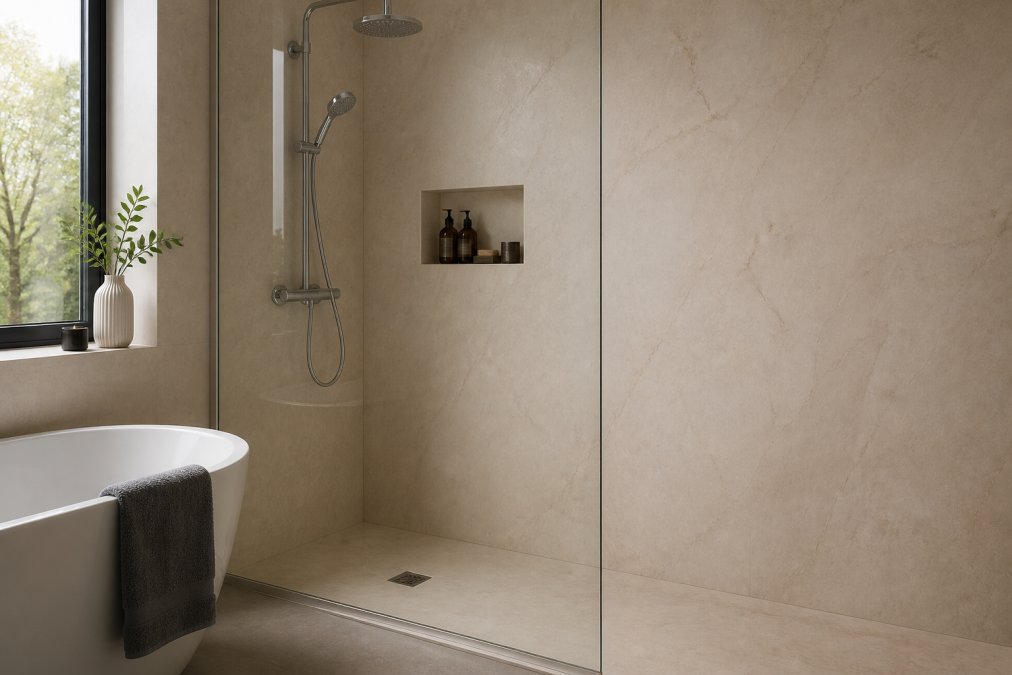
These 100% waterproof panels come with a 5-year guarantee and use a tongue and groove design that makes installation straightforward. For a tighter budget, the Decorwall Elegance Ultimo Tile Cleveland at £59.00 offers a flush-fitting tile effect without any grouting, while the Decorwall Elite Print Sandstone at £11.00 per board is ideal for smaller cloakrooms or feature walls.

Alternative 2: Upgrade Fixtures and Fittings Only
If your suite is structurally sound but looks tired, upgrading the fixtures and fittings delivers a disproportionate visual return. A new chrome basin mixer, a modern bath filler, and a replacement shower head can modernise the entire aesthetic for a fraction of a suite's cost.
The Wendover Straight Multirail Gloss White at £56.00, for example, replaces an old towel rail and instantly adds a contemporary ladder design.
Alternative 3: Mix New Sanitaryware with Existing Pieces
A middle path between full replacement and simple refresh is mixing new sanitaryware with your existing pieces. If your bath is in good condition but the basin and WC are dated, replacing just those two elements can modernise the room while preserving the most expensive item. The Vista 550mm Vanity & C/C Toilet Pack at £295.00 includes a 560mm basin unit with an integrated ceramic basin and a close-coupled rimless WC with a soft-close seat; the Volta 410mm F/S Basin Unit & C/C Toilet Pack offers the same value for tighter spaces.
Budget Bathroom Renovation Ideas That Cut Labour Costs
Labour is where most budgets bleed out, so reducing the hours a tradesperson needs on site is the fastest way to save. Budget bathroom renovation ideas should therefore focus on products that a competent DIYer can install.
Every time you relocate a WC or basin, you introduce new soil pipe runs, boxing-in work, and floor repairs. Instead, work within your existing footprint and spend your money on high-impact surfaces.
The DIY vs Professional Installation Cost Reality
DIY installation of wall panels, vinyl flooring, and replacement fixtures can cut total project costs by 40-60% compared to a fully trade-installed suite, but that saving only materialises if you are honest about your skill level. The realistic split is:
- DIY-friendly tasks: Wall panel fitting, painting, vinyl floor laying, changing a shower head, swapping a towel rail, fitting a new toilet seat, and refacing cabinet doors. These require basic tools and a weekend.
- Borderline tasks: Replacing a basin or WC where the soil pipe or waste alignment is unchanged. This is achievable for many DIYers but carries risk, a poorly seated WC can leak, and a misaligned basin waste can cause damp issues.
- Leave to a professional: Moving waste pipes, altering soil stacks, rewiring for new lighting or electric showers, and any work involving gas or major structural changes. Attempting these to save money often ends in costly remedial work.
A realistic cost-benefit analysis for a typical UK bathroom refresh looks like this:
| Task | DIY Cost (materials only) | Professional Cost (materials + labour) | Typical Saving | Risk Level |
|---|---|---|---|---|
| Fit wall panels over tiles (10m²) | £300-£500 | £900-£1,400 | £600-£900 | Low, panels are forgiving |
| Paint existing tiles with specialist bathroom paint | £60-£100 | £250-£400 (if you pay a decorator) | £190-£300 | Medium, prep is critical |
| Replace basin and WC (same position) | £250-£400 | £600-£900 | £350-£500 | Medium, plumbing connections |
| Fit vinyl click flooring (5m²) | £150-£250 | £400-£600 | £250-£350 | Low |
| Move a WC to a new position | £800-£1,500 (materials + soil pipe) | £2,500-£4,000 | Not worth DIY | High, almost always professional |
Refacing Instead of Replacing
One of the most underused budget alternatives is refacing existing furniture rather than buying new. If your vanity unit is structurally sound but the doors are dated, replacing just the doors and drawer fronts can save 50-70% of the cost of a new vanity. Professional bath reglazing typically costs £200-£350 in the UK, compared to £400-£800 for a new bath plus installation and disposal (checkatrade.com).
The Second-Hand and Upcycled Route
For UK homeowners willing to hunt, there are genuine bargains in pre-owned fixtures:
- Salvage yards and architectural reclamation stores, these often stock high-quality cast-iron baths, vintage brass taps, and solid-wood vanity units at 30-60% below new retail prices. Many are located in industrial estates and list stock online.
- Online marketplaces, Gumtree, Facebook Marketplace, and Freecycle regularly feature bathroom suites being removed during renovations. A common pattern is a homeowner giving away or selling cheaply a perfectly good suite because they want a different colour or style. Collection and disposal are usually the buyer's responsibility, so factor in van hire (£50-£80 for a day) and careful transport.
- Ebay and specialist bathroom resellers, some sellers purchase ex-display or end-of-line stock from bathroom showrooms at a discount. This is a lower-risk way to buy new-but-cheaper sanitaryware, though you must check for transit damage on delivery.
What to Skip to Save the Most
If your budget is genuinely tight, the fastest savings come from removing items from the scope entirely:
- Skip the new bath. A shower-over-bath configuration with a new shower head and a glass screen costs far less than a separate walk-in shower enclosure.
- Skip underfloor heating. Electric underfloor heating mats add £200-£400 in materials plus installation time. A plumbed towel rail or a simple heated towel radiator achieves much of the comfort benefit for a fraction of the cost.
- Skip bespoke joinery. Off-the-shelf vanity units and wall cabinets from UK DIY retailers are far cheaper than custom-built options and are designed to fit standard UK pipework positions.
The overarching principle is to spend money where it is visible, walls, lighting, and fixtures, and save where it is hidden, pipework, structure, and anything that requires a specialist to access.
Small Bathroom Design Hacks 2026: Maximise Impact
For narrow ensuites and compact bathrooms, small bathroom design hacks 2026 are about creating the illusion of space while adding storage. Large-format panels in light, earthy tones reflect light and reduce the visual busyness that small tiles create.
The Kerradeco Stone Grey at £209.00 per pack covers 3.186m² with eight boards and brings a natural stone texture that suits a modern spa-throom aesthetic. For a brighter finish, the Dumawall+ High Gloss Mura at £3.95 per panel delivers a sleek, contemporary shine that helps bounce light around a tight space.

The Psychology of Small-Space Design
The single biggest mistake in small bathrooms is trying to make them look bigger by using white everywhere, which often results in a sterile space that feels smaller because there is no visual anchor. Instead, the 2026 trend is to use a continuous tone, soft sage, warm greige, or muted terracotta, across walls and floor. This removes the horizontal line where wall meets floor, which is what visually chops up a small room. A continuous colour approach works particularly well with large-format panels because the minimal grout lines create an unbroken surface, letting the eye travel without stopping.
Storage That Works With, Not Against, the Space
Small bathrooms fail when storage competes with movement. The practical hacks that survive contact with real UK homes are:
- Vanity units with integrated basins, a 400mm or 450mm wide vanity unit with a basin on top uses the same floor footprint as a pedestal basin but adds drawer space underneath. The Volta 410mm F/S Basin Unit & C/C Toilet Pack at £295.00 is a prime example, it replaces a dated pedestal basin and adds storage without widening the footprint.
- Mirrored cabinets with internal shelves, a standard mirror over the basin is wasted space. A mirrored cabinet with adjustable shelves adds 20-30 litres of storage in the same wall area (victorianplumbing.co.uk). Look for models with demister pads and integrated LED lighting to combine three functions in one fixture.
- Over-toilet shelving or cabinets, the space above the cistern is almost always unused. A narrow floor-standing shelving unit or a wall-mounted cabinet that fits around the cistern adds significant storage without encroaching on floor space.
- Recessed shower niches, if you are fitting wall panels in a shower enclosure, plan for a recessed niche or use a surface-mounted caddy. A niche cut into the panel avoids the bulky corner caddies that collect soap scum and visually clutter the space.
Lighting as a Spatial Tool
Lighting is the most underrated tool in small bathroom design. A single ceiling light creates shadows and leaves corners dark, making the room feel smaller. The practical approach for UK bathrooms is:
- Install a wall-mounted light above the mirror, this eliminates shadows on the face and makes the room feel taller.
- Use LED strip lighting under the vanity unit, this creates a floating effect that visually lifts the furniture off the floor.
- Consider a shower light with IP65 rating, a separate light in the shower area removes the dark zone that a single ceiling light creates.
All lighting in a bathroom must be IP-rated (IP44 minimum for zones 2 and 3, IP65 for zone 1 inside the shower) (electricalsafetyfirst.org.uk). This is a UK wiring regulation requirement, not a style choice.
The Vertical Space Hack
Most small bathrooms have unused vertical space above eye level. The hack is to use it:
- Tall, narrow storage towers, a 300mm wide, floor-to-ceiling tower unit fits beside a basin or WC and provides more storage than a wide, low cabinet.
- Wall-mounted towel rails above the door, a heated towel rail mounted high on the wall above the door frame is unconventional but works in ensuites where floor space is at a premium.
- Extend wall panels to the ceiling, if you are fitting panels, take them all the way up rather than stopping at a dado height. This draws the eye upward and makes the ceiling feel higher.
The Unique Angle: The 'One Less Thing' Rule
A design hack that most trend articles miss is the 'one less thing' rule: for every new item you introduce, remove one existing item. If you add a mirrored cabinet, remove the separate mirror and the shelf above the basin; if you add a heated towel rail, remove the freestanding towel stand; if you add a storage tower, remove the over-door hooks. This forces discipline and prevents the slow accumulation of clutter that makes small bathrooms feel like cupboards.
What to Avoid in a Small Bathroom
Equally important is knowing what not to do:
- Avoid large-format floor tiles in dark colours, they show every water mark and make the floor feel like it is closing in.
- Avoid wall-hung WCs unless the wall is solid, the boxing-in required for concealed cisterns can eat into an already tight space.
- Avoid corner baths, they consume more floor area than a standard straight bath and rarely provide the luxury feel they promise in small rooms.
- Avoid busy patterns on all surfaces, a feature wall in a bold pattern works, but patterned walls plus patterned floor plus patterned accessories creates visual chaos.
The most effective small bathroom designs in 2026 commit to a single continuous surface treatment, add storage in the vertical plane, and use lighting to remove shadows, mechanisms that work regardless of whether your budget is £300 or £3,000.
Conclusion
The common advice that a dated bathroom needs a full suite replacement is outdated. By refreshing walls with large-format panels, upgrading fixtures, and mixing new sanitaryware with existing pieces, you can achieve a modern, uncluttered look without the labour costs of a complete remodel. Wetwall Wonders supplies everything you need in one place, from Dumawall tile effects to installation adhesives, silicones, and trims.
Frequently Asked Questions
What are the cheapest alternatives to a full bathroom suite?
The most cost-effective alternative is to keep your existing bath, toilet, and basin, and focus on the surfaces. Replacing old tiles with large-format wall panels like the Decorwall Maxi Panels in Beige Marble costs far less than new ceramics and eliminates the labour of grouting. Upgrading only the fixtures, such as taps and a new shower, gives a modern look for a fraction of the cost of a full suite.
Are wall panels a cheaper alternative to bathroom tiles?
Yes, wall panels are often cheaper than tiles when you include installation. Tiles require adhesive, grout, and a skilled fitter for a waterproof finish. Panels like the Dumawall+ High Gloss Mura click together with a tongue and groove design and can be fitted directly over existing tiles, saving on labour and materials. A pack of eight Mura panels costs £3.95 per panel, making it a budget-friendly option.
How can I renovate my bathroom without buying a full suite?
Start by assessing what you can keep. If your bath and toilet are in good condition, focus your budget on wall cladding, a new basin unit, and updated fixtures. The Vista 550mm Vanity & C/C Toilet Pack at £295 provides a modern vanity and toilet if you need to replace those items, while you keep your existing bath. This approach lets you refresh the look without the cost of a complete suite.
What is the best way to avoid an outdated bathroom design in 2026?
Focus on timeless, uncluttered surfaces rather than trend-led colours. Large-format panels with earthy tones or subtle marble effects, such as the Kerradeco Stone Grey range, create a spa-like feel that stays current. Avoid busy patterned tiles and chrome-heavy fittings, which date quickly. Instead, pair neutral walls with modern, space-saving fixtures and programmed lighting for a look that will last.

