
Best Moisture Resistant Wall Coverings for Bathrooms Compared
Quick Summary
The best moisture resistant wall coverings for bathrooms are solid PVC and wood plastic composite panels, which resist water absorption and do not warp, rot or grow mould. Their weak point is unsealed joints and cut edges, so wet-area silicone at every junction is essential for lasting results.
- Dumawall+ High Gloss Mura starts at £3.95 and offers a tile-effect finish with a 10-year warranty.
- Decorwall Maxi Panels in Beige Marble cost £54.00 each and cover large shower walls quickly with a 5-year guarantee.
- Decorwall Elite Print Aquarius is 250mm wide and costs £11.00, making it suited to narrow ensuites.
- Moisture-resistant MDF tolerates humidity and splashes only, so it is unsuitable for direct, repeated water contact.
- Seal every cut edge, joint and tray junction with wet-area silicone, since unsealed edges are the most common failure point.
Table of Contents
- What Makes a Wall Covering Moisture Resistant
- Bathroom Wall Panels vs Tiles: How They Compare
- Waterproof Bathroom Wall Panels Compared Side by Side
- Moisture-Resistant MDF Panelling and Other Core Materials
- Tile Effect Wall Panels: Finishes and Styles
- Installation Risks, Costs and Maintenance
- Choosing Your Bathroom Wall Covering and Ordering Your Panels
- Frequently Asked Questions
What Makes a Wall Covering Moisture Resistant
Last Updated: November 2, 2026
Bathrooms are the hardest test for any wall covering. Steam, splashes and standing water hit the walls every day, and a surface that copes with a kitchen splashback can still swell, stain or peel in a shower.
A moisture resistant covering is one whose core and surface resist water absorption, so it does not warp, rot or grow mould on the back.
Moisture Resistance Versus Waterproofing
These terms are often used interchangeably, but they mean different things. Moisture resistance describes how well a material copes with humidity and occasional splashes. Waterproofing describes whether water can pass through the surface and into the wall behind it at all.
Many products are described as "100% waterproof", and the Dumawall+ and Decorwall ranges are marketed that way. The joints are what matter in practice.
Bathroom Wall Panels vs Tiles: How They Compare
Tiles remain the traditional choice, and they are durable when laid well. Their weak point is the grout, which is porous, discolours and cracks, giving water a route behind the surface.
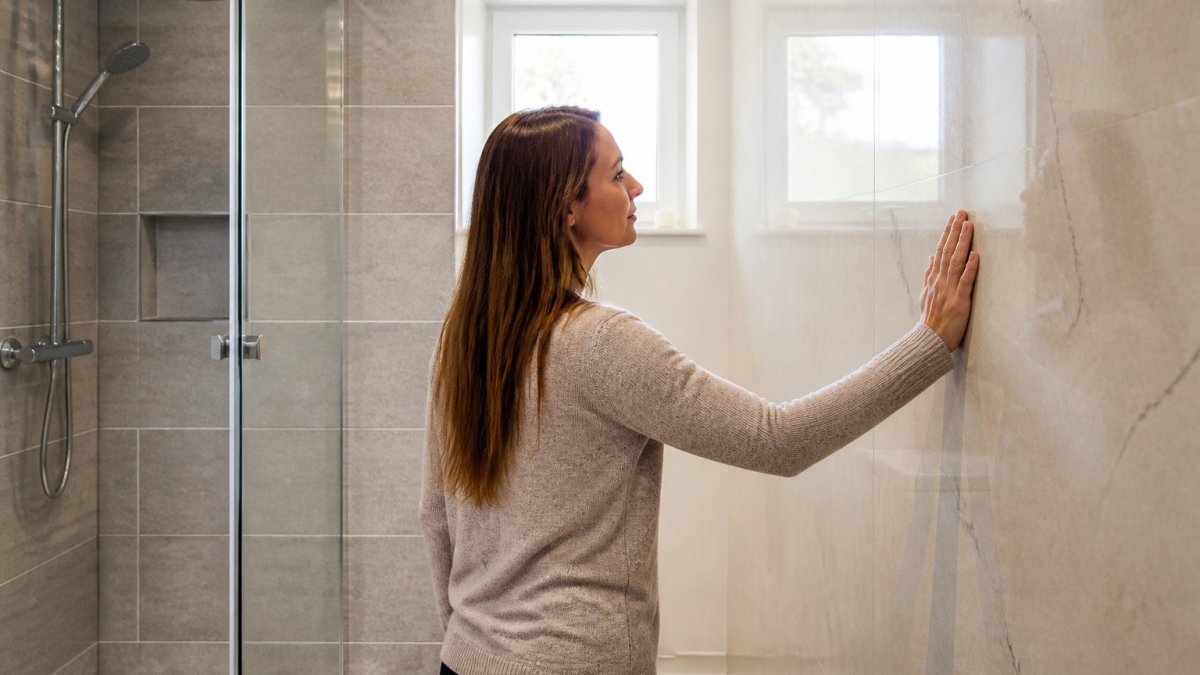
Cost and labour are where the comparison changes. A tiled wall usually needs a skilled tiler, levelling work and a longer drying programme.
!A homeowner in a modern bathroom running a hand along a glossy tile-effect wall panel beside a shower, natural daylight from a small window
Waterproof Bathroom Wall Panels Compared Side by Side
The table below sets out the key specifications and starting prices for five panels from our range. All prices are in GBP.
| Panel | Starting Price | Best For |
|---|---|---|
| Dumawall+ High Gloss Mura | £3.95 | Tile-effect finish in wet rooms |
| Decorwall Maxi Panels, Beige Marble | £54.00 | Large, fast-covering shower walls |
| Kerradeco Stone Grey | £209.00 | Natural stone look |
| Hardex Solid Wall Panel | £126.00 | Hard-wearing commercial and residential use |
| Decorwall Elite Print Aquarius | £11.00 | Narrow ensuites and small spaces |
Dumawall+ High Gloss Mura
Dumawall+ is a heavy-duty PVC panel with a bright, high-gloss surface. It is 100% waterproof, UV-resistant and colourfast, and it comes with a 10-year manufacturer's warranty. The micro grout line gives a tile look. At £3.95, it is the lowest-cost entry point in this list, but each board covers a small area.
Decorwall Maxi Panels in Beige Marble
These 2400mm by 900mm panels cover a large wall quickly, cutting down on joints and fitting time. They are 100% waterproof, use a tongue-and-groove design and carry a 5-year guarantee. At £54.00 each, they cost more per board than the Dumawall+ but far less per square metre of wall covered, and they work best where the wall is reasonably flat. You can see or order the Decorwall Maxi Panels in Beige Marble here.

Kerradeco Stone Grey
Kerradeco Stone Grey is a premium PVC panel inspired by natural stone textures. Each pack holds 8 boards at 1350mm by 295mm, covering 3.186m² at £209.00, the highest price on this list for a single pack, so it is a considered purchase. Its strength is the natural-stone look in a clean, hygienic material, suiting projects where the design brief calls for stone without the weight or cost of real stone. You can check or purchase the Kerradeco Stone Grey panel directly.

Hardex Solid Wall Panel
The Hardex panel is built from wood plastic composite in eight colours, with a flush square edge, measuring 2.4m long and 1220mm wide. At £126.00, it is aimed at both residential and commercial work. Its look is more functional than decorative.
Decorwall Elite Print Aquarius
At 2700mm by 250mm by 8mm, the Aquarius board is the narrowest panel we stock. It is 100% waterproof, fire-rated and easy to fit and clean, and it costs £11.00. That narrow profile suits a tight ensuite, a cloakroom or a boxed-in corner where wider boards would leave awkward cuts. If you are unsure whether Elite or Maxi suits your room, compare Decorwall Elite and Maxi Panels side by side.
Moisture-Resistant MDF Panelling and Other Core Materials
Not every wall covering is a solid plastic board, and the core material is the single biggest predictor of how a panel will behave in a humid room. The table below compares the four core types most commonly sold for bathroom and kitchen walls.
| Core type | Water exposure it tolerates | Durability in humid rooms | Appearance options | Installation demands | Typical cost band |
|---|---|---|---|---|---|
| Solid PVC | Splashes, steam and occasional direct spray; joints must be sealed | Very good, does not swell or rot | Tile-effect, gloss, matt, stone print | Light; cut with a fine-tooth blade, seal cut edges | Low to mid |
| Acrylic-faced board | Splashes and steam; not for continuous running water | Good, face is non-porous, core varies | High-gloss and print finishes | Moderate; edges and joints need sealing | Mid |
| Compact laminate | Splashes and steam; tolerant of wet rooms when joints are sealed | Very good, dense, dimensionally stable | Realistic stone and timber effects | Heavy; needs sharp tooling and mechanical fixings | High |
| Moisture-resistant MDF (MR MDF) | Humidity and occasional splashes only | Fair, resists swelling but is still wood-based | Paint, veneer, laminate face | High; all faces and cut edges must be sealed | Low to mid |
| Wood plastic composite (WPC) | Splashes and steam; joints must be sealed | Good, stable and rot-resistant | Tile and stone effects | Moderate; similar to PVC | Mid |
What the comparison means in practice
Solid PVC and WPC are commonly used for shower walls. Acrylic-faced boards perform well where the face stays intact, but a chip or unsealed cut edge exposes the core, so edge trims are not optional.
Watch out: a product described as moisture-resistant is not automatically suitable for a shower enclosure. MR MDF and some acrylic-faced boards are intended for splash zones and general humidity, not for walls that receive direct, repeated water contact.
Matching the core to the room
A simple rule works for most projects. For inside a shower or above a bath, choose a solid PVC, WPC or compact laminate core with sealed joints. For a splashback behind a basin, kitchen sink or utility room, an acrylic-faced or MR MDF panel is adequate provided every cut edge is sealed and the wall behind is dry. For a basement or a room with persistent damp, no decorative panel is a substitute for fixing the source of the moisture first.
What to check on the data sheet
Rather than relying on the word waterproof, look for evidence. A useful panel data sheet will state water absorption, dimensional stability under humidity, joint or seam performance, and any fire classification. If a supplier cannot provide those figures, treat the claim as marketing rather than a specification. The joint detail, not the panel face, is where moisture problems usually begin, so ask how the system seals at corners, at the shower tray and at any cut edge.
Tile Effect Wall Panels: Finishes and Styles
Many homeowners want the look of tile without the grout. Tile-effect panels solve this by printing or moulding a tile pattern onto the board.
Finish choice matters. High-gloss surfaces reflect light and make a small bathroom feel larger, but they also show water marks and fingerprints more readily. Matt and textured finishes hide marks better. Pick the finish you will be willing to wipe down most days.
Installation Risks, Costs and Maintenance
Panels are simpler to fit than tiles, but the job still has failure points, and the total cost is rarely just the panel price. This section sets out the risks, a realistic installed-cost breakdown and the maintenance routine that keeps a panel wall performing.
Substrate preparation and the risks that matter
The wall behind the panel decides whether the installation lasts. Panels should go onto a flat, sound and dry substrate.
Ventilation matters as much as the panel.
Sealing is the most common weak point. To choose a suitable waterproof adhesive for shower panels, compare solvent-free options, curing times and application techniques.
Watch out: cutting a panel and leaving the cut edge unsealed is one of the most common installation mistakes.
Total installed cost, not just panel price
A useful budget adds the accessories and preparation to the panel cost. The table below gives indicative ranges for a typical bathroom wall project; actual figures depend on wall condition, panel choice and whether you fit it yourself.
| Cost element | Indicative range | Notes |
|---|---|---|
| Panels | £25-£60 per m² | Varies widely by core and finish |
| Adhesive | £8-£15 per tube | Allow several tubes per wall |
| Wet-area silicone | £5-£12 per cartridge | One or more per room |
| Trims and edge profiles | £10-£30 per length | Corners, ends and tray junctions |
| Substrate preparation | £0-£40 per m² | Levelling or repair where walls are poor |
| Labour (if not DIY) | £150-£350 per day | A small bathroom is often a one- to two-day job |
| Annual maintenance | £0-£20 | Replacement sealant every year or two |
Maintenance routine
Maintenance is light but not zero. Wipe panels with a warm cloth and a mild cleaner, and avoid abrasive pads that scratch the surface. Check the silicone every year and replace any that has cracked or lifted, keep the extractor fan clean and running during and after showers, and inspect the sealant line near the shower tray every few months, because that is where water first gets behind the surface.
Where panels are not the right choice
Panels suit bathrooms, shower rooms, kitchens, utility rooms and cloakrooms. They are a poor fit where a wall is persistently damp, where the substrate cannot be made sound, or where a heritage or period interior calls for traditional tiling. In those cases, fixing the underlying moisture problem or choosing a different finish is the better decision than covering it over.
Choosing Your Bathroom Wall Covering and Ordering Your Panels
Start with the room. A narrow ensuite points towards the 250mm Aquarius board, because wide panels leave awkward cuts. A large, flat shower wall suits the 2400mm Decorwall Maxi panels.
Next, work out how much you need. Measure each wall, add a margin for cuts and waste, and divide by the coverage per pack.
Finally, order everything from one supplier. Wetwall Wonders stocks the panels and the installation accessories together, which keeps the project on schedule.
Frequently Asked Questions
What is the best moisture-resistant wall covering for a bathroom?
For many bathrooms, PVC wall panels are a practical choice because they are described as 100% waterproof and are easy to clean with a warm cloth. The Dumawall+ High Gloss Mura range is sold in packs of 8 from £3.95 per panel and carries a 10-year manufacturer's warranty, while the Kerradeco Stone Grey pack costs £209.00 and covers 3.186m². The right option depends on your layout, budget and the look you want, so compare panel sizes and finishes before ordering.
Are bathroom wall panels better than tiles?
Bathroom wall panels use tongue and groove joints and do not need grout, which is one reason they are a common alternative to tiles. Tiles can suit very large or heavy-duty areas, but grout lines need regular cleaning and can crack over time. Panels with a micro grout line, such as Dumawall+, give a tiled look without the upkeep of real grouting.
Can moisture-resistant MDF panelling be used in a bathroom?
Moisture-resistant MDF is sometimes used in bathrooms, but it can swell if water gets behind it or the edges are not properly sealed. For wet areas, fully waterproof PVC or solid wall panels are generally a safer choice. If you do use MDF in a damp room, seal all cut edges and joints carefully with the correct silicone and make sure the room is well ventilated.
Are PVC wall panels suitable for shower walls?
Yes, PVC wall panels are used for shower walls and are described as 100% waterproof. The Decorwall Maxi Panels in Beige Marble (2400mm x 900mm x 10mm, from £54.00) are described as suitable for shower boards and carry a 5-year guarantee. Make sure the wall behind is sound and sealed at the corners and joints before fitting.


