
Bathroom Wall Panels vs Tile: Pros and Cons for 2026
Table of Contents
- Bathroom Wall Panels vs Tile: The Quick Comparison
- Pros and Cons of Bathroom Wall Panels
- Pros and Cons of Bathroom Tiles
- Bathroom Wall Panels vs Tiles Cost: What You Actually Pay
- Bathroom Wall Panel Installation: Time, Tools and Substrate Prep
- Can Wall Panels Go Over Tiles? What You Need to Know
- How to Clean Bathroom Wall Panels and Keep Grout Mould-Free
- Repairs, Lifespan and End-of-Life: The Costs Nobody Mentions
- Frequently Asked Questions
Last Updated: October 6, 2026
Bathroom Wall Panels vs Tile: The Quick Comparison
Choosing between bathroom wall panels and tile comes down to one trade-off: panels are faster, cheaper to fit and easier to live with, while tile offers a harder-wearing, more traditional finish. Bathroom wall panels are large-format sheets, often PVC-based, that click or glue onto the wall as a seamless surface.

The short version: for a fast, low-maintenance refresh with no grout to scrub, panels win. For an immovable, tile-through-and-through finish with the budget and time, tile still has the edge.
| Factor | Wall Panels | Tile |
|---|---|---|
| Typical install time | A day or less for a shower surround | Several days plus drying |
| Grout lines | None | Many |
| Mould risk | Very low | Higher in grout |
| Main weak point | Seals and joints | Grout and cracked tiles |
| Best for | DIY, quick refreshes, wet rooms | Long-term, high-traffic finishes |
Pros and Cons of Bathroom Wall Panels
Wall panels win on speed, hygiene and low maintenance, but the result depends on correct substrate prep and sealed joints.
Where Panels Win
The biggest advantage is a seamless surface with no grout lines, no grout for mould to colonise and no scrubbing between tiles.
Installation is quick: most panels fix with adhesive, and tongue-and-groove designs click together, so a shower surround can go up in hours rather than days. Our own range includes the Decorwall Elegance Ultimo Tile panels at £59.00, which are 100% waterproof and require no grouting.

Where Panels Fall Short
Panels are not as hard as porcelain: a dropped tool or heavy impact can dent or scratch a panel, whereas tile would shrug it off.
The other weak point is the seals. Water gets behind panels when the silicone at the base, corners or shower recesses fails, which is why substrate prep and quality sealant matter more than the panel itself.
Pros and Cons of Bathroom Tiles
Tile remains the benchmark for a permanent finish: hard, heat-resistant and available in an enormous range of colours, patterns and formats. The downsides are the labour, the grout, and the cost of undoing a poor installation.
Where Tile Still Wins
Nothing matches tile for durability. Ceramic and porcelain resist scratches, heat and impact far better than a panel surface, and a well-fitted tiled wall can last decades with just a wipe and the occasional re-grout.
Tile also offers design flexibility that panels can only imitate: mix formats, lay patterns, and choose from a vast palette. For a period property or statement feature wall, tile is often the only option that looks right.
Where Tile Costs You More
The cost of tile is not just the tile: it is the adhesive, grout, spacers, trim, tanking and above all the labour. A tiler's day rate adds up fast, and a full bathroom can take several days before drying time.
Grout is the long-term cost: it stains, cracks, and is the first place mould appears in a damp bathroom, so keeping grout lines clean is ongoing work.
Bathroom Wall Panels vs Tiles Cost: What You Actually Pay
On upfront cost, panels are usually cheaper once labour is counted. The material price is comparable, but panels cut the biggest line item, fitting time, and a confident DIYer can remove the labour cost almost entirely.
Tile carries hidden costs that rarely appear in the headline price: tanking, extra adhesive, replacement tiles for cuts and breakages, and the tiler's time.
A Like-for-Like Lifecycle Comparison
Most comparisons stop at the sticker price. The honest way to compare is to model the whole job over a stated period, because the two materials front-load and back-load their costs differently.
| Cost line | Wall panels | Tile |
|---|---|---|
| Materials (surface) | Sheet price per m² | Tile price per m², plus 10-15% cutting/breakage waste |
| Preparation | Adhesive, silicone, trims; substrate must be flat and sound | Adhesive, grout, spacers, trim, tanking membrane in wet areas |
| Labour | Typically a day or less for a shower surround | Several days, plus drying time between coats and grouting |
| Making good | Minimal; sheets cut to size | Cutting, drilling for fixtures, grout finishing |
| Ongoing maintenance | Wipe-down; periodic silicone replacement at joints | Grout cleaning; occasional re-grout and re-seal |
| Repairs | Replace a full panel if damaged | Replace individual tiles if spares match |
| End-of-life | Lighter, less bulky to remove and dispose of | Heavy, bulky; skip or licensed waste disposal |
Over a 10-year horizon, most fitters describe this pattern: panels cost less on day one and less per year to maintain, but may need replacing once if seals are neglected.
Where the Money Actually Goes
The biggest single line in either job is labour, not material. A tiler's day rate across several days usually exceeds the cost of the tiles themselves, while a panel shower surround can be fitted in hours.
The cost that catches people out later is not the surface but the seal and the grout. Silicone hardens, shrinks and lifts, and needs periodic replacement on both materials; grout needs cleaning and eventually raking out and re-grouting.
If you plan to stay put for 20 years, tile's longevity can justify the higher upfront spend. If you are refreshing a rental or selling within a few years, panels usually win on value because the buyer is paying for the look, not the substrate.
Bathroom Wall Panel Installation: Time, Tools and Substrate Prep
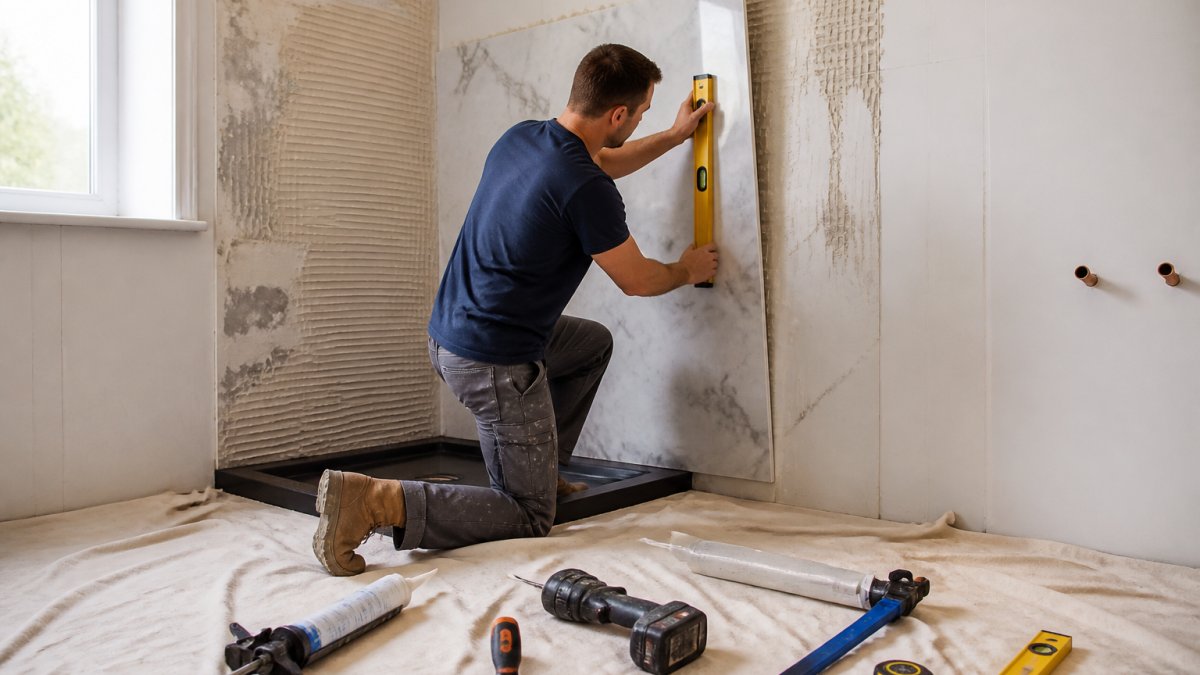
Bathroom wall panel installation is a DIY-friendly job that typically takes a day for a shower surround, but only if the wall behind it is sound. The panels are the easy part. The wall preparation decides whether the job lasts.
What "Waterproof" Actually Means
A panel can be 100% waterproof as a material and still let water into the wall. Waterproof describes the sheet, not the installation.
That is why the specification that matters is not the panel's waterproof rating but the sealing system: bathroom-grade, mould-resistant silicone at every joint, applied to a clean, dry surface and given full curing time before the shower is used.
Substrate Preparation: The Step That Decides the Job
Start with the substrate: the wall must be flat, dry and clean. Fix any loose plaster, flaking paint or damp patch first, because adhesive bonds to the wall, not to a crumbling surface.
Decorwall Elegance Ultimo Tile Cleveland →
Panels are often blamed for what was actually a substrate failure. Adhesive needs a sound, dust-free surface to grip; PVA-sealed or glossy painted walls, greasy walls and residual wallpaper paste all reduce the bond.
Tools and Sequence
You will need a tape measure, spirit level, fine-tooth saw or knife, sealant gun, quality adhesive and bathroom-grade silicone. Measure twice, cut once, dry-fit each panel before committing to adhesive, work from a true corner and keep each sheet level.
Finish by sealing every joint, internal corner and the base where the panel meets the tray with mould-resistant silicone, and give it full curing time before the shower is used. Get this right and the installation will outlast the decor.
Can Panels Go Over Existing Tile?
Yes, wall panels can go over existing tiles, provided the tiled wall is flat, sound and firmly bonded.
The conditions matter. Any loose, hollow or drummy tiles must be removed and the gap filled flush.
Going over tiles saves disposal costs and days of labour. It also raises the floor-to-ceiling height slightly, which is worth checking against your shower screen and any fixtures.
Can Wall Panels Go Over Tiles? What You Need to Know
Yes, wall panels can go over existing tiles, provided the tiled wall is flat, sound and firmly bonded.
The conditions matter. Any loose, hollow or drummy tiles must be removed and the gap filled flush.
Going over tiles saves disposal costs and days of labour. It also raises the floor-to-ceiling height slightly, which is worth checking against your shower screen and any fixtures.
How to Clean Bathroom Wall Panels and Keep Grout Mould-Free
Cleaning bathroom wall panels takes minutes because there is no grout to scrub. A warm, damp cloth and a mild bathroom cleaner are usually enough. For a tiled wall, the same job means working a brush along every grout line.
Here is how to clean bathroom wall panels:
- Wipe the surface with a warm, damp cloth after most showers.
- Use a mild, non-abrasive bathroom cleaner for soap scum.
- Avoid abrasive pads and harsh solvents that can dull the finish.
Mould needs moisture and a porous surface. Panels remove the porous grout, so there is far less for mould and bacteria to cling to.
Repairs, Lifespan and End-of-Life: The Costs Nobody Mentions
The costs that catch people out arrive years later: a cracked tile, a failed seal, a scratched panel.
Tile is repairable in small sections, but matching a discontinued tile is often impossible, and removing one tile without cracking its neighbours takes skill.
End-of-life matters too. Ceramic and porcelain are heavy and bulky to dispose of, and a skip for tiled waste is not cheap.
On lifespan, tile has the longer track record. A well-installed tiled wall can outlast the bathroom around it.
Frequently Asked Questions
Which is better for my bathroom, bathroom wall panels or tiles?
It depends on your priorities. Bathroom wall panels suit anyone who wants a fast, low-maintenance refurbishment: they are 100% waterproof, need no grouting, and wipe clean with a warm cloth. Tiles suit anyone who wants a traditional finish with unlimited colour and pattern choice, but they demand more labour, more substrate preparation, and ongoing grout care. For a shower surround or wet room, panels remove the grout lines where mould and leaks usually start.
What are the downsides of bathroom wall panels?
The main drawbacks are fewer design options than ceramic or porcelain tile, and the need for careful substrate preparation. If the wall behind a panel is uneven or damp, the panel can flex, peel or bubble, so the wall must be flat, dry and clean before fitting. Localised damage is also harder to disguise than swapping a single tile, though a full panel replacement is straightforward.
Are bathroom wall panels cheaper to install than tiles?
Usually, yes. The panels themselves start at around £54 to £59 per panel, and because they need no grout, adhesive beds or specialist cutting, labour time drops sharply. Tiling carries lower material costs per square metre but higher labour costs, plus grout, spacers and sealant. For a full bathroom wall panel installation, most of the saving comes from fitting a large-format panel in one pass rather than setting dozens of individual tiles.
Can bathroom wall panels be fitted over existing tiles?
Yes, panels can go over tiles if the existing surface is sound, flat and firmly bonded. Loose or hollow tiles must be removed first, and any mould behind the old tiling needs treating before you cover it. A tongue and groove panel, such as the Decorwall Maxi range, clicks together and can be fixed with adhesive, which keeps the job simple. Check that door frames, trims and shower screens still fit once the extra panel thickness is added.
How long do bathroom wall panels last compared with tiles?
A well-fitted panel from a solid-core range can last many years, and brands back this with guarantees: the Decorwall Maxi range carries a 5-year guarantee, while Dumawall+ panels carry a 10-year manufacturer's warranty. Ceramic and porcelain tiles can outlast that if the grout is maintained, but grout is the weak point. Once grout cracks or discolours, water reaches the substrate and the tile job can fail long before the tile itself wears out.
The real challenge is not choosing between panels and tile; it is getting either one installed so it lasts. Seals, substrate and adhesive decide that, not the surface you see. At Wetwall Wonders, we supply the full system in one place: 100% waterproof panels in sizes including 500mm and 900mm, plus the silicones, adhesives and trims that make the job last. Search our range and get everything you need for a bathroom that stays watertight and easy to clean.

