
How to Select Waterproof Panels for Modern Bathrooms
Table of Contents
- Quick Comparison: Waterproof Panel Options at a Glance
- Bathroom Wall Panels vs Tiles: Which Suits a Modern Bathroom?
- PVC Bathroom Wall Panels: What to Check Before You Buy
- Installing Waterproof Shower Panels: Substrate, Adhesive and Seals
- Durability, Fire Safety and Environmental Impact
- Matching Finishes to a Contemporary Design
- Common Mistakes When Choosing Waterproof Panels
- Conclusion
- Frequently Asked Questions
Last Updated: September 27, 2026
Quick Comparison: Waterproof Panel Options at a Glance
Waterproof panels are interlocking wall boards, typically PVC-based, that replace tiles in wet areas by creating a grout-free, water-tight surface. For anyone learning how to select waterproof panels for modern bathrooms, the decision usually comes down to three formats: slim 250mm planks for tight spaces, mid-width 300mm panels for balanced coverage, and large-format 900mm boards for minimal seams. Wetwall Wonders supplies all three, plus the adhesives, silicones and trims that hold the system together.
| Panel Type | Size (L x W x T) | Best For | Price |
|---|---|---|---|
| Decorwall Elite Print, Arctic Grey | 2700mm x 250mm x 8mm | Narrow ensuites, alcoves | £11.00 |
| Decorwall Elegance Mineral, Calcite | 2700mm x 300mm x 8mm | Stone-effect feature walls | £22.00 |
| Decorwall Maxi, Beige Marble | 2400mm x 900mm x 10mm | Shower enclosures, wet rooms | £54.00 |
| Decorwall Maxi, Matt Misty Stone | 2400mm x 900mm x 10mm | Full-height wet room walls | £59.00 |
The pattern is simple: the narrower the room, the narrower the panel. A 250mm plank wastes less material in a tight ensuite, while a 900mm board covers a shower enclosure in three or four drops with almost no seams.

Bathroom Wall Panels vs Tiles: Which Suits a Modern Bathroom?
Wall panels win on speed and maintenance; tiles win on resale familiarity. That is the honest trade-off, and most guides gloss over it.
Grout is the weak point of any tiled bathroom. It is porous, it stains, and it needs resealing periodically to stop moisture penetration reaching the substrate behind. Panels eliminate grout entirely. The surface is a single moisture-resistant sheet, so there is nothing to scrub with a toothbrush and no anti-mould treatment to reapply every few months.
Where tiles still hold an edge is in the resale conversation. Some buyers expect ceramic, and a fitted tiled wall reads as a permanent fixture. Panels, by contrast, are a wall cladding system: faster to fit, easier to replace, and increasingly accepted in contemporary design.
Cost is closer than people assume once you add up adhesive, grout, sealant, spacers and the labour for a tiler. If you are renovating a bathroom yourself, the DIY bathroom case for panels is strong: a homeowner can clad a shower enclosure in an afternoon with a decent adhesive and a silicone gun.
PVC Bathroom Wall Panels: What to Check Before You Buy
PVC bathroom wall panels are the default choice for wet areas because the core itself is waterproof, not just the surface coating. Check four things before ordering: core material, thickness, fire rating, and UV protection.
The core matters most. A cheap panel with a thin decorative skin over a hollow or composite core can delaminate if water reaches an unsealed edge. A solid PVC core will not. The Decorwall Elite Print, for instance, is 77% PVC and rated 100% waterproof, with no lead content, which makes it suitable for bathroom cladding and shower boards.
Fire rating is the check most buyers skip. Any panel going on a wall should carry a UK fire rating, and the Decorwall Elite Print does. UV protection is a separate spec: it matters less in a windowless ensuite, but if daylight hits the wall, an unprotected panel can yellow over time. The Decorwall Maxi Misty Stone is UV protected and UK fire rated, with a 5-year guarantee.

Panel Thickness, Width and Waterproof Core
Thickness runs from 8mm to 10mm in most ranges, and the difference is rigidity, not waterproofing. An 8mm panel is fine for a standard wall; a 10mm board flexes less over a large span and feels more solid underhand.
Width decides your seam count. A 250mm plank suits a narrow space where a wide board would need trimming on every drop. A 900mm board suits a shower enclosure where you want two or three clean drops and a seamless seal at the corners.
Installing Waterproof Shower Panels: Substrate, Adhesive and Seals
Installing waterproof shower panels is a three-part job: prepare the substrate, bond the panels with the correct adhesive, then seal every joint and edge with silicone. Skip any one of the three and the system fails.
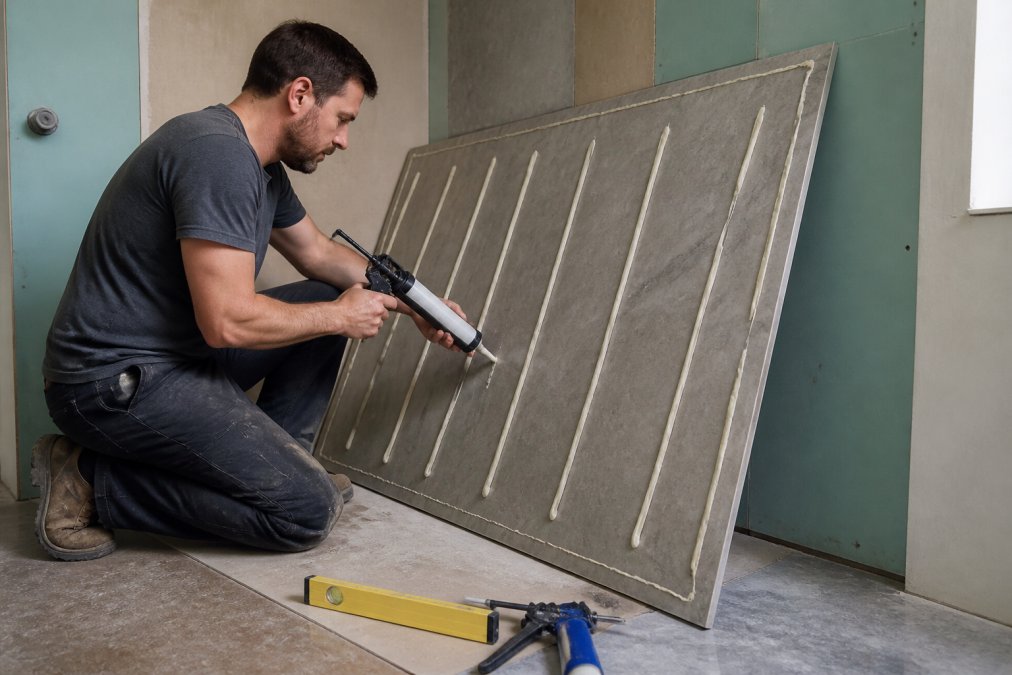
Start with the substrate. Panels bond to a flat, dry, sound surface. If you are cladding over existing tiles, they must be firmly attached and level; loose tiles will telegraph through. If you are going back to bare plasterboard, check it is moisture-resistant board in wet zones. Any high spots need sanding back, because a panel bonded over an uneven wall will show every bump.
Next, the adhesive. Apply it in vertical beads or a full bed, depending on the panel and the manufacturer's guidance, then press the panel home and check it with a spirit level before the adhesive grabs. Tongue and groove panels click together edge to edge, which keeps the joint tight and helps alignment.
Finally, the seals. Run a continuous bead of silicone down every internal corner, along the tray line, and around any cut edge. This is the layer that actually keeps water out of the wall cavity, so use a bathroom-grade silicone rather than a general-purpose sealant.
Decorwall Elite Print- Arctic Grey →
Substrate Preparation for Wet Rooms and Shower Enclosures
Wet rooms are less forgiving than a standard bathroom because water reaches the whole floor and lower wall, not just the shower zone. The substrate behind a wet room panel needs to be dimensionally stable and fully dry before cladding goes on.
A common mistake is bonding panels over fresh plaster or newly skimmed walls. Residual moisture gets trapped behind the panel with nowhere to escape, and the adhesive never cures properly. Let new plaster dry fully first, then check with a moisture meter if you have one.
For shower enclosures, the tray-to-wall junction is the critical detail. The panel should sit above the tray upstand where one exists, with silicone forming the water-tight seal between them. Never rely on the panel edge alone to shed water.
Durability, Fire Safety and Environmental Impact
Long-term durability comes down to the core, the seal, and UV exposure. A solid PVC panel with sealed edges and a UV-protected face will outlast a cheap composite board by years in a bathroom.
Fire safety is a UK regulatory matter, not a nice-to-have. Panels specified for wall cladding should carry a UK fire rating, and both the Decorwall Elite Print and the Maxi range do. If you are cladding a rental property or a commercial washroom, check the rating on the spec sheet before ordering.
On environmental impact, PVC is recyclable but not biodegradable, so end-of-life disposal matters. The practical argument for panels over tiles is longevity plus lower maintenance: fewer replacement cycles, less sealant, and no grout to redo. Fewer materials over the life of the room is the honest sustainability case here, not a claim that PVC is a green material.
Matching Finishes to a Contemporary Design
Finish choice is where most buyers overthink and under-decide. The three families that cover almost every modern bathroom are tile-effect, stone-effect, and wood-effect, and each reads differently in a small room.
Tile-effect panels give you the tiled look without the grout.
Common Mistakes When Choosing Waterproof Panels
The biggest mistake is buying on appearance alone and ignoring the spec sheet. A panel that looks right but has no fire rating, no UV protection and a hollow core will disappoint within a couple of years.
Conclusion
Getting the spec right, core, thickness, fire rating, substrate and seal, is what separates a bathroom that still looks sharp in five years from one that needs redoing in two. The finish is the easy part; the engineering behind it is what lasts.
Frequently Asked Questions
What are the disadvantages of wet wall panels?
The main drawbacks are visible seams where panels meet, unless you choose tongue and groove edges for a tighter fit, and a higher upfront cost than basic ceramic tiles. Cheaper panels can feel hollow when tapped and may scratch if cleaned with abrasive pads. Fire ratings vary by product, so check the listing: some panels carry a UK fire rating and others do not. Panels also cannot be re-grouted or patched the way tiles can, so a deep gouge means replacing the whole panel.
How long do waterproof panels last in a modern bathroom?
Longevity depends on the panel and the installation. Decorwall Maxi Panels, for example, come with a 5-year guarantee and are UV protected, which helps them resist discolouration in bright bathrooms. The bigger factor is what happens behind the panel: if the substrate is dry, flat and sealed with the correct adhesive and silicone, panels stay put for years. Water getting behind a poorly sealed panel is what causes bubbling and peeling, not the panel itself.
Are PVC bathroom wall panels suitable for wet rooms and shower enclosures?
Yes, provided the panel is rated 100% waterproof and the edges are sealed properly. Options like the Decorwall Elite Print Arctic Grey panel are designed for bathroom cladding and shower areas, and the Decorwall Maxi Panel in Misty Stone is made for bathrooms, wet rooms and shower enclosures. Use a waterproof adhesive, seal all joints and corners with silicone, and leave a small gap at the bottom rather than butting panels tight against the tray.
Do waterproof panels require special maintenance?
No grout means no scrubbing grout lines, which is the main maintenance advantage over tiles. A soft cloth and a non-abrasive bathroom cleaner are enough for day-to-day cleaning. Avoid scourers, bleach-heavy sprays and anything abrasive, as these dull the surface. Check the silicone seals around the tray and corners every few months and reapply if they crack, since the seal, not the panel, is what keeps water out of the wall behind it.

