
Multipanel alternatives for small bathrooms
Table of Contents
- Why homeowners choose multipanel alternatives for small bathrooms
- Bathroom wall panels vs tiles: which works best in compact spaces
- Small bathroom wall panels: size, material and design considerations
- Installing bathroom wall panels over tiles: practical steps and constraints
- Waterproof bathroom wall panels: materials, durability and long-term performance
- Cost comparison: panels versus tiles and installation labour
- Cleaning, maintenance and warranty: what to expect after installation
- Frequently Asked Questions
Last Updated: October 10, 2026
Why homeowners choose multipanel alternatives for small bathrooms
Small bathrooms demand solutions that don't compromise on style or practicality, which is why multipanel alternatives small bathrooms are increasingly popular. Traditional tiles have dominated bathroom design for decades, but they come with real drawbacks: grout lines trap moisture and dirt, installation takes time and skill, and replacing damaged tiles means disrupting the entire wall. This is where multipanel alternatives for small bathrooms make sense.
Multipanel alternatives are wall boards made from PVC or acrylic-style materials that offer waterproofing, durability, and a cleaner aesthetic without the maintenance burden of grout. For compact spaces, they're particularly valuable. Narrow panel widths (250mm and 300mm) fit tight corners and alcoves where full-width tiles would require extensive cutting. Light finishes and stone-effect designs visually expand confined areas. Installation happens faster than tiling, often without needing a professional.
Below, we'll show you exactly how to evaluate multipanel alternatives for your space, what materials actually perform in humid environments, and how installation and cost stack up against traditional options.
Bathroom wall panels vs tiles: which works best in compact spaces
The core difference comes down to maintenance, installation speed, and visual impact. Tiles require grout lines that harbour moisture and mould, especially problematic in small bathrooms with limited air circulation. Wall panels eliminate grout entirely, using seamless joins or visible micro grout lines that are far easier to clean.
Tiles demand skilled installation. Walls must be perfectly flat, spacing must be precise, and grouting takes time and expertise. Wall panels, by contrast, use adhesive or mechanical fixing and can be installed in a single day, sometimes by a confident DIYer.
Visually, tiles in small spaces can feel busy. Grout lines create visual breaks that chop up the wall, making the room feel smaller. Panels with continuous finishes and light colours (beige marble, misty stone, sandstone) create an unbroken visual flow that makes compact bathrooms feel more spacious.

Cost-wise, the comparison depends on what you're comparing. Budget tiles plus professional labour can match or exceed the cost of quality panels with installation.
The real advantage for small bathrooms: panels adapt to tight dimensions without waste. A 250mm or 300mm panel width fits narrow walls and alcoves perfectly. Tiles come in fixed sizes; cutting them to fit creates waste and visible seams that interrupt the design.
Small bathroom wall panels: size, material and design considerations
Panel width and thickness for tight spaces
Panel width is critical in compact bathrooms. Standard tiles are typically 300mm or 400mm square, which means cutting for narrow spaces. Wall panels come in narrower widths by design: 250mm, 300mm, 500mm, and 900mm options let you choose the proportions that suit your wall.
A 250mm panel width works well in ensuite bathrooms and alcoves where walls are constrained. It creates a balanced visual rhythm without overwhelming a small space. The Building Research Establishment guidance on bathroom design notes that visual continuity in confined spaces improves perceived spaciousness; narrower panel widths support this by reducing visual breaks.
Thickness matters less visually but affects durability. Decorwall Elite Print panels at 8mm thickness strike a practical balance, suitable for most residential bathrooms.
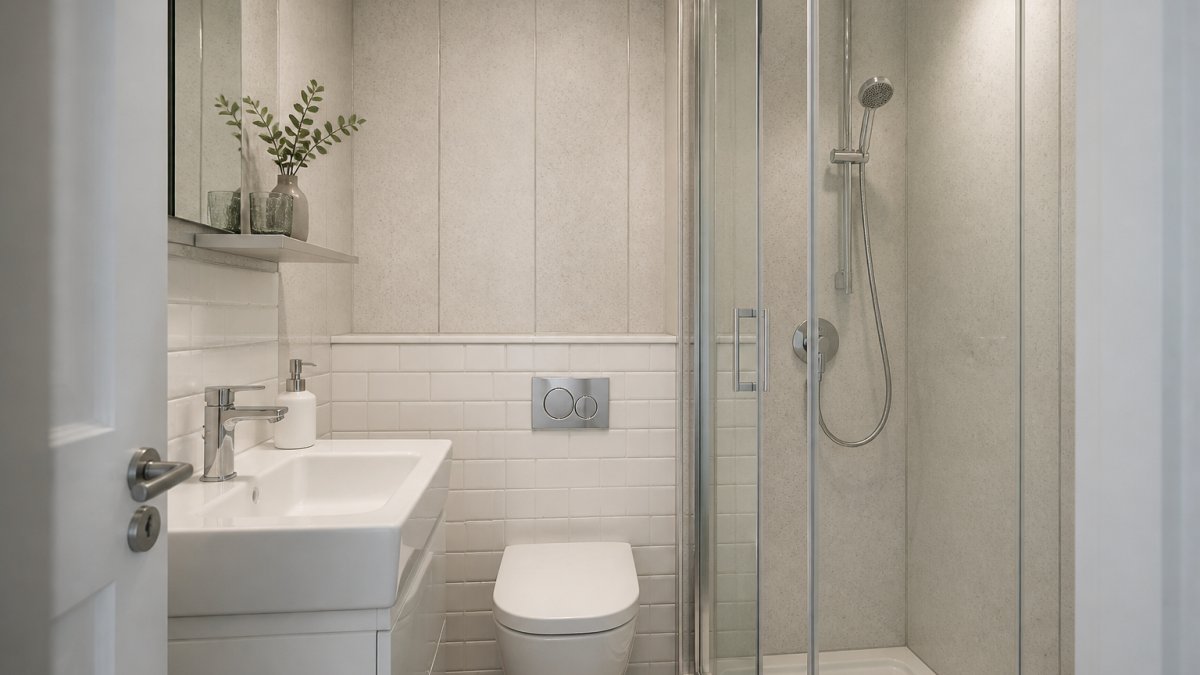
Tile-effect and stone-effect finishes to expand visual space
Finish choice shapes how a small bathroom feels. Gloss finishes reflect light, making rooms feel brighter and more open. Matte finishes absorb light and create a softer, more luxurious aesthetic but can feel heavier in tight spaces.
Stone-effect and tile-effect designs are popular because they deliver familiar aesthetics without grout maintenance. Beige marble, misty stone, and sandstone finishes work particularly well in small bathrooms. Light colours visually recede, making walls feel farther away and the room larger. Darker finishes (charcoal, slate) create a cosy feel but can make compact spaces feel smaller.

Dumawall+ High Gloss Mura panels offer tile-effect finishes with a micro grout line visible but no actual grout to maintain. You see and feel the line without the mould and staining problems. The high gloss finish brightens small spaces, and the tile-effect design is familiar and timeless.
Decorwall Maxi Panels in Beige Marble or Misty Stone deliver stone-effect aesthetics with 100% waterproof protection. The continuous finish creates visual flow, while the stone effect adds depth without visual clutter. These are particularly effective in bathrooms under 5 square metres where every design choice affects perceived size.
Installing bathroom wall panels over tiles: practical steps and constraints
Most homeowners ask: can I install panels over existing tiles? The answer is yes, with caveats.
Existing tiles provide a stable base if they're firmly adhered and not loose. You don't need to remove them, which saves time and labour. The process is straightforward: clean the tile surface thoroughly, apply adhesive (typically silicone or panel-specific adhesive), and press panels firmly. Seams are sealed with silicone to prevent water ingress.
The constraint: tile surfaces must be flat and stable. Loose or cracked tiles will cause panels to sit unevenly or fail. If more than 10% of the tiled area is compromised, removal is safer. Check by tapping tiles; a hollow sound indicates poor adhesion.
For new installations on bare walls, preparation is critical. Walls must be clean, dry, and as flat as possible. Any bumps or moisture will cause adhesive failure. Silicone-based adhesives work best for bathroom environments; they cure moisture-resistant and remain flexible (important in humid spaces where thermal expansion occurs).
Installation labour typically costs £300-£600 for a small bathroom (under 10 square metres) depending on wall condition and whether tiles are being removed. DIY installation is viable if you're comfortable with adhesive application and can work methodically. Most panels can be cut with a fine-toothed saw or jigsaw if trimming is needed.
Trims and corners require attention. Internal corners use corner trim to hide raw edges; external corners use edge trim. Wetwall Wonders supplies these alongside adhesives and silicones, ensuring you have everything needed in one order rather than chasing multiple suppliers.
Waterproof bathroom wall panels: materials, durability and long-term performance
Waterproofing is non-negotiable in bathrooms. Panels must resist moisture penetration, which causes swelling, mould, and structural failure.
Decorwall Maxi Panels-Beige Marble 2400mm x 900mm x 10mm →
Quality panels are 100% waterproof PVC or acrylic-based materials. PVC is the industry standard: it's rigid, doesn't absorb water, and resists mould. Acrylic-style panels offer similar performance with a slightly softer feel.
The weak point isn't the panel itself; it's the seams and joints. Water that seeps behind panels causes damage. This is why silicone sealing is critical. A continuous bead of bathroom-grade silicone around seams, corners, and where panels meet the shower tray prevents water ingress. The silicone must cure fully (typically 24-48 hours) before the bathroom is used.
Decorwall Maxi Panels carry a 5-year guarantee covering manufacturing defects. Dumawall+ offers a 10-year manufacturer's warranty, reflecting confidence in durability. These guarantees cover material failure, discolouration, and structural integrity under normal use. They don't cover installation defects, which is why proper sealing matters.
Long-term performance depends on ventilation. A bathroom with poor air circulation traps moisture, which can eventually cause mould at seams or behind panels if silicone fails. Adequate extraction (a fan running during and 20 minutes after showers) prevents this.
Cost comparison: panels versus tiles and installation labour
A realistic cost comparison for a small bathroom (5 square metres of wall coverage) looks like this:
| Option | Material Cost | Labour Cost | Total | Durability |
|---|---|---|---|---|
| Budget ceramic tiles | £80-150 | £400-600 | £480-750 | 5-7 years |
| Quality wall panels | £150-300 | £300-500 | £450-800 | 10+ years |
| Premium stone tiles | £200-400 | £500-800 | £700-1200 | 7-10 years |
Panel costs vary by finish and brand. Decorwall Elite Print Sandstone panels are £11 per panel; Decorwall Elegance Mineral Calcite panels are £22 per panel; Decorwall Maxi Panels (Beige Marble or Misty Stone) are £54-59 per panel. Dumawall+ High Gloss Mura tiles are £3.95 per pack (8 tiles, 1.95m² coverage).

For a 5m² bathroom, you'd need approximately 5-6 Maxi Panels or 20-25 Dumawall+ packs. Material cost ranges from £80-300 depending on which product you choose. Add adhesive, silicone, and trims (typically £40-80), and total materials are £120-380.
Labour for professional installation runs £300-500 for a small bathroom. DIY installation saves this entirely but requires confidence with adhesive application and cutting.
Which? consumer research on bathroom renovation costs shows homeowners underestimate labour costs and often encounter unexpected expenses (structural repairs, water damage) during tile removal. Panels reduce this risk because they can be installed over existing surfaces.
Cleaning, maintenance and warranty: what to expect after installation
Panels are genuinely low-maintenance compared to tiles. No grout means no grout cleaning, which is the most labour-intensive part of tile upkeep.
Weekly cleaning: wipe panels with a damp cloth and mild detergent. Dumawall+ panels with their micro grout line are wiped clean in seconds. Stubborn soap residue can be removed with a soft brush and bathroom cleaner. Abrasive scouring pads aren't needed and can damage the finish.
Monthly: check silicone seams for discolouration or mould. If mould appears, clean with bathroom mould spray and ensure ventilation improves.
Damage repair: if a panel cracks or dents, the affected panel can be removed and replaced without disturbing surrounding panels. Replacement panels are inexpensive (£11-60 depending on the product).
Warranties on quality panels cover manufacturing defects for 5-10 years. Decorwall Maxi Panels offer 5 years; Dumawall+ offers 10 years. These warranties do not cover installation errors, poor sealing, or damage from impact or chemical exposure. They do cover discolouration, warping, or material failure under normal bathroom use.
Silicone isn't warrantied but is inexpensive to replace. A tube of bathroom silicone costs £3-8, and resealing a seam takes 10 minutes. This is far cheaper than regrouting tiles.
The practical reality: after installation, panels require almost no attention beyond routine cleaning.
Choosing the right wall solution for a small bathroom comes down to balancing durability, aesthetics, and maintenance burden, and multipanel alternatives small bathrooms excel in all three areas. Multipanel alternatives offer genuine advantages over tiles in compact spaces: faster installation, no grout maintenance, better use of narrow dimensions, and lower long-term costs. Wetwall Wonders supplies a complete range of panel options, from Decorwall Elegance Mineral panels at 300mm width (£22) to Dumawall+ tile-effect boards (£3.95 per pack), alongside all necessary adhesives, silicones, and trims. With a 5-10 year guarantee and straightforward installation, you can transform a cramped bathroom into a modern, durable space that stays looking fresh without constant upkeep. Get started with Wetwall Wonders and simplify your bathroom renovation.
Frequently Asked Questions
What is the best multipanel alternative for a small bathroom?
The best choice depends on your space and budget. For tight ensuites, narrow panels like the Decorwall Elite Print (250mm width, £11.00) work well because they minimise awkward seams. For larger small bathrooms, the Decorwall Maxi Panels (900mm width, £54.00-£59.00) offer fewer joints and faster installation. All are 100% waterproof PVC, grout-free, and easier to clean than tiles. Consider your wall dimensions and whether you prefer tile-effect or stone-effect finishes.
Are waterproof bathroom wall panels suitable for shower areas in small spaces?
Yes. Waterproof bathroom wall panels are specifically designed for wet rooms and shower enclosures. PVC panels like Dumawall+ (£3.95 per pack, 10-year warranty) and Decorwall Maxi Panels (5-year guarantee) are 100% waterproof and UV-resistant. They resist moisture better than grout-based tiles because they have no grout lines where water can seep behind. Proper adhesive and silicone sealant application during installation prevents water ingress at seams and joints.
Can you fit wall panels over existing bathroom tiles without removing them?
Yes, you can install panels over existing tiles if the tile surface is clean, dry, and not loose. The wall must be prepared by washing and roughing the surface so adhesive bonds properly. However, this approach adds thickness and may reduce headroom in very small bathrooms. Removing old tiles before installation is often better for small spaces because it preserves clearance and allows you to check for moisture damage behind the tiles. Use quality panel adhesive and silicone to seal all seams and joints.
How do small bathroom wall panels compare to tiles in terms of cost and installation time?
Material costs vary: narrow panels like Decorwall Elite Print start at £11.00, while larger Maxi Panels cost £54.00-£59.00. Total installed cost favours panels in most small bathroom projects.

