
Why Do Bathroom Wall Panels Bubble? Causes and Fixes
Table of Contents
- Common Causes of Bubbling in Bathroom Wall Panels
- How to Fix Bathroom Wall Panelling
- Bathroom Wall Panel Installation Mistakes to Avoid
- The Best Adhesive for Bathroom Wall Panels
- Repair or Replace? A Visual Diagnostic Checklist
- Preventing Future Bubbling: Ventilation and Maintenance
- Frequently Asked Questions
Last Updated: September 15, 2026
Common Causes of Bubbling in Bathroom Wall Panels
Bubbling in bathroom wall panels is almost always a moisture or bond problem, not a manufacturing defect. Water gets in where it shouldn't, the panel face loses its grip on the core or the wall behind it, and the result is a soft, raised blister that spreads if ignored. Bubbling in bathroom wall panels is almost always a moisture or bond problem, not a manufacturing defect. Water gets in where it shouldn't, the panel face loses its grip on the core or the wall behind it, and the result is a soft, raised blister that spreads if ignored. The cause is usually one of four failures: moisture ingress, adhesive failure, substrate movement, or a product never suitable for a wet zone.
Understanding why bathroom wall panels bubble starts with recognising that a panel is a system: the panel, adhesive, sealant, and substrate must all work together. When one part fails, bubbling is the visible symptom.
Moisture Ingress and Humidity
Moisture ingress is the single most common cause of bubbling. Bathrooms generate heavy steam, and if that vapour reaches the back of a panel, it will. Waterproof composite core panels resist water on their own, but cut edges, joints, and bottom seals are where moisture gets in.
Two mechanisms do the damage. Capillary action draws water upward behind the panel through a hairline gap at a bottom edge or unsealed cut edge. Vapour pressure traps warm, moist air behind the panel, which condenses against the colder wall and attacks the adhesive layer. Once the bond softens, the panel face lifts away from the core.
High humidity makes both worse. A bathroom without an extractor fan, or with a blocked one, holds condensation against surfaces long after a shower ends (the NHS). That is why bubbling often appears near grout lines, at the bottom of a panel run, or directly above a shower tray, where water sits longest.
Adhesive Failure and Poor Application
Adhesive failure is the second major cause, and it is almost always an application problem. Panels need a full, even bed of a suitable panel adhesive, not a few dabs at the corners.
The type of adhesive matters more than most people realise. A standard acetoxy-cure silicone is a sealant, not an adhesive, it flexes and seals a joint but cannot carry a panel's weight, so thermal expansion from hot showers gradually works the panel loose until it bubbles. A general-purpose grab adhesive is the opposite problem: it grabs hard but cures rigid, so as the panel expands and contracts, the bond cracks and separates from the substrate.
A dedicated panel adhesive sits between the two. Water-based panel adhesives give a strong initial grab and a full cure within a day, suiting standard internal fitting. Hybrid polymer adhesives stay flexible and bond under damper conditions, suiting wet rooms and difficult substrates. The wrong choice in either direction shows up as bubbling months later.

Substrate Preparation and Wall Condition
A third cause is the substrate itself. Panels are only as flat and dry as the wall behind them. If the wall is dusty, greasy, or still carrying old tile adhesive, the adhesive bonds to the contamination rather than the wall, and the panel lifts as a sheet. If the wall is even slightly damp, the adhesive cannot cure properly, and trapped moisture becomes vapour that pushes the panel away.
Wall flatness matters too. A wall out by more than a few millimetres across a panel run forces the panel to bridge the hollow, leaving an air gap that collects condensation, and the unsupported section bubbles first. Checking wall moisture content and flatness before fitting prevents more callbacks than any other single step.
Product Suitability for Wet Zones
Finally, some bubbling is simply the wrong product in the wrong place. A panel rated for a splash zone is not the same as one rated for inside a shower enclosure or wet room. Fit a standard panel where it is permanently in the line of water and the core can take on moisture over time even if the surface looks sealed, delaminating from the inside out. Checking the manufacturer's wet-zone rating before fitting is the cheapest insurance against this.
How to Fix Bathroom Wall Panelling
Fixing bubbling depends on how far the damage has spread. A small bubble on an otherwise sound panel can often be repaired in place; if the panel has delaminated across a large area or the core is wet, replacement is the only reliable option.
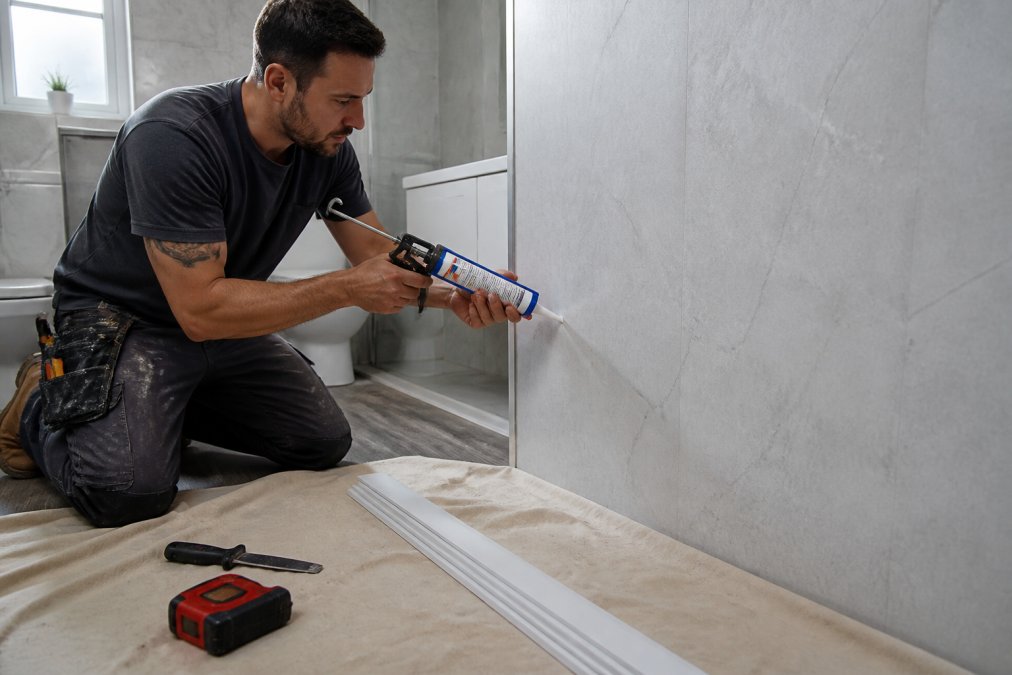
For a small, localised bubble, work through these steps:
- Find the source. Check the nearest joint, trim, or bottom edge for a failed seal. Fixing the bubble without fixing the leak means it returns.
- Dry the area completely. Use a hairdryer on a low setting or leave it to dry for 24 hours. Adhesive will not bond to a damp surface.
- Re-secure the panel. Inject a panel adhesive behind the lifted section using a syringe or fine nozzle, then press the panel flat and weight it until the adhesive grabs.
- Re-seal the joint. Once cured, run a fresh bead of mould-resistant silicone along the affected joint.
If the panel has warped, cracked, or the core feels soft, stop. That panel is done, and no amount of adhesive will bring it back.
Bathroom Wall Panel Installation Mistakes to Avoid
Most bubbling traces back to installation, so most of it is preventable. The useful question is not just "what went wrong" but "which mistake caused this specific bubble, and can I still fix it?" The mistakes below account for most callbacks in the industry, each paired with the symptom it produces so you can diagnose an existing problem rather than just avoid a future one.

Substrate Mistakes
- Poor substrate preparation. Walls must be clean, dry, and reasonably flat.
Adhesive and Sealant Mistakes
Ventilation and Trim Mistakes
Using This as a Diagnostic Guide
Repair or Replace: A Quick Decision
The Best Adhesive for Bathroom Wall Panels
| Product | Type | Best For | Cure Time |
|---|---|---|---|
| Decorwall Panel Adhesive Pro (310 ml) | Water-based panel adhesive | Standard internal panel fitting | Ready in 1 hour, full cure in 24 |
| Decorwall Megabond Adhesive (295 ml) | Hybrid polymer adhesive | Damp or difficult substrates | Bonds under water |
| GP200 Silicone Sealant (Pack of 3) | Acetoxy cure silicone with fungicide | Sealing joints and edges | Fast setting |
Repair or Replace? A Visual Diagnostic Checklist
Preventing Future Bubbling: Ventilation and Maintenance
Frequently Asked Questions
What are the common causes of bubbling in PVC wall panels?
Bubbling in PVC wall panels usually comes from moisture ingress, adhesive failure, or poor substrate preparation. When water gets behind the panel through unsealed joints, it can't escape and pushes the panel away from the wall. Using the wrong adhesive or applying it incorrectly also creates gaps where air and damp collect. High humidity in a poorly ventilated bathroom speeds up the process. Fixing the root cause, not just the bubble, is essential to stop it returning.
Can moisture trapped behind wall panels cause bubbling?
Yes. Moisture trapped behind panels is one of the main reasons bathroom wall panels bubble. It happens when water seeps through unsealed edges, around fittings, or through failed silicone. Without a way to escape, the moisture builds pressure and separates the panel from the wall. In a wet room or splash zone, even small gaps can let in enough water to cause problems. Proper sealing with a fungicidal silicone like GP200 and a waterproof adhesive such as Decorwall Megabond Adhesive helps prevent this.
Is it possible to repair bubbled bathroom wall panels?
In many cases, yes. If the bubbling is limited to a small area and the panel is otherwise sound, you can cut out the affected section, dry the substrate, and re-bond with a suitable adhesive like Decorwall Panel Adhesive Pro. However, if the bubble covers a large area or the panel has warped, replacement is usually more reliable. Always check for underlying moisture issues first. Our guide on how to fix bathroom wall panelling covers the steps in detail.
Does poor adhesive application lead to panel delamination?
Absolutely. Poor adhesive application is a leading cause of delamination. If you use the wrong type of adhesive, apply it in insufficient quantity, or fail to press the panel firmly, gaps form behind the panel. Moisture and air then collect in these gaps, causing the panel to lift and bubble. Using a dedicated panel adhesive like Decorwall Panel Adhesive Pro or Decorwall Megabond Adhesive, and following the manufacturer's instructions, gives a secure bond that resists moisture.
Bubbling panels are a moisture and bonding problem, not a mystery, and catching them early saves you a full refit. Wetwall Wonders supplies the full system in one place, from waterproof composite core panels in 250mm, 300mm, 500mm, and 900mm widths to the adhesives and silicones that keep them sealed. Explore the Wetwall Wonders range and get everything you need for a bathroom that stays flat, sealed, and watertight.

