
10 Creative Bathroom Mirror Ideas for Small Spaces
Last Updated: October 29, 2026
Quick Summary
The best creative bathroom mirror ideas for small spaces include full-height mirror walls, round mirrors that soften tight corners, storage mirrors with built-in shelving, and backlit LED models that brighten the room. Choose size and placement by measuring the basin width and wall space first.
- Keep a round mirror's diameter at roughly 60-75% of the basin width.
- Position the bottom edge of a mirror about 10-15cm above the basin rim.
- Use a stud and cable detector before drilling to avoid hidden pipes or wiring.
- Light from the sides rather than directly overhead to reduce shadows on the face.
- Check your tenancy agreement before fixing anything to the wall if you rent.
Table of Contents
- Why the Right Mirror Changes a Small Bathroom
- 1. Large Floor-to-Ceiling Mirror Walls
- 2. Round Bathroom Mirror Ideas for Softer Lines
- 3. Space-Saving Bathroom Mirrors With Integrated Storage
- 4. Small Bathroom Mirror Cabinet Options
- 5. Backlit LED Mirrors That Brighten Tight Spaces
- 6. Small Bathroom Mirror Ideas for Rentals and No-Drill Fits
- 7. Choosing Size, Placement and Lighting Before You Buy
- Frequently Asked Questions
Why the Right Mirror Changes a Small Bathroom
In a small bathroom, the mirror does more work than almost any other fitting. It reflects light, makes the room feel bigger, and often serves as the main storage and grooming point. Get it right and a cramped ensuite can feel open. Get it wrong and it looks like an afterthought.
Wetwall Wonders has put together this guide to help you choose creative bathroom mirror ideas for small spaces. The ideas below cover shape, size, storage, lighting and fitting, so you can narrow your options before you buy.
A mirror that spans most of a wall can make a tight room feel much larger. A round mirror softens hard corners. A slim cabinet adds storage without eating into floor space. Each choice trades something off, so it helps to know what you need before you start.
1. Large Floor-to-Ceiling Mirror Walls
A full-height mirror wall is one of the most effective creative bathroom mirror ideas for small spaces. It reflects the basin, the window and the opposite wall, which can add a sense of depth. Many homeowners find this works best on the wall facing the main light source.
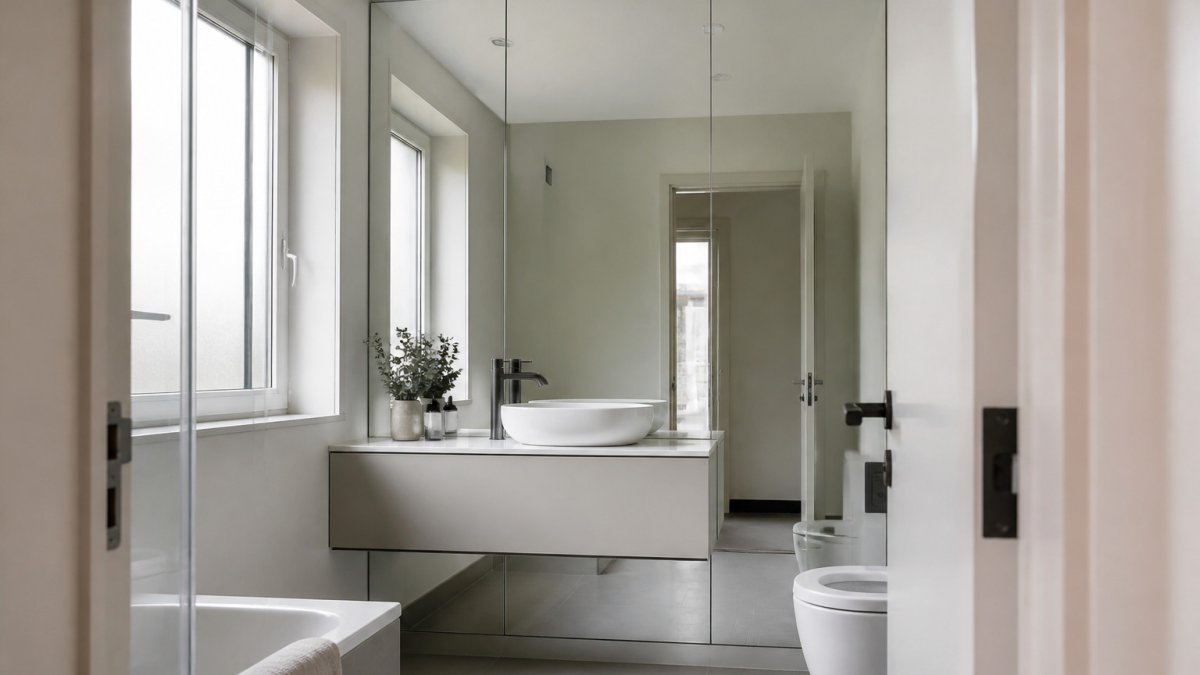
The trade-off is cost, weight and fitting. Large glass sheets need solid, level backing and careful sealing around the edges to keep moisture out. Plan for professional fitting unless you are confident with panel work.
2. Round Bathroom Mirror Ideas for Softer Lines
Round mirrors suit small bathrooms where hard rectangles feel crowded. They soften the room and pair well with curved basins or rounded tapware. A round mirror also avoids the sharp corners that can catch the eye in a narrow space, and because the eye reads a circle as a single calm shape, it can make a tight wall feel less busy than a rectangle of the same width.
The practical question is diameter. A useful rule of thumb is to keep the mirror diameter at roughly 60-75% of the basin width, so a 500mm-wide basin pairs well with a 300-375mm mirror, while a 600mm basin suits a 360-450mm mirror. If the mirror hangs on a wall with no basin beneath it, size it to about one-third to one-half of the wall width so it reads as a deliberate feature rather than a porthole. Keep the bottom edge around 10-15cm above the basin rim, and check that the top of the mirror sits comfortably below eye level when you stand at the basin, a mirror that is too high forces you to look up and distorts the reflection.
Round mirrors work particularly well above a single basin, and they are a strong choice in narrow rooms because the curve breaks up the parallel lines of the walls. Pair a round mirror with a slim shelf or a wall-mounted light on either side rather than above, so the circle stays unobstructed. In a very small room, a frameless or thin-rim round mirror reflects more light than a wide, deep frame, which can visually eat into the wall.
For a softer, less geometric look, consider an irregular or pebble-shaped mirror. These are cut to an organic outline rather than a true circle, so they break up the wall without the formality of a perfect round. They are harder to find in standard sizes, so measure the wall carefully and check the fixing points before ordering. A round or irregular mirror also pairs well with a demister pad fitted behind it, which keeps the surface clear in a steamy room without adding a visible element to the design.
Round mirrors are easier to size once you know the basin width, and the article gives clear proportions to follow.
| Basin width | Suggested round mirror diameter | Note |
|---|---|---|
| 500mm | 300-375mm | 60-75% of basin width |
| 600mm | 360-450mm | 60-75% of basin width |
| Wall with no basin | One-third to one-half of wall width | Reads as a feature |
| Bottom edge height | 10-15cm above basin rim | Keeps mirror clear of tap |
3. Space-Saving Bathroom Mirrors With Integrated Storage
Mirrors with built-in shelving or a recessed cabinet are a practical answer to limited space. They keep toiletries off the basin and remove the need for a separate unit. This is one of the most useful small bathroom mirror ideas for busy households.
Look for shelves with a depth that suits your products, and confirm the cabinet hinges and fixings are rated for the wall construction you have.
4. Small Bathroom Mirror Cabinet Options
Cabinet mirrors come in slim profiles that sit neatly within a small footprint. Corner styles can use awkward angles that other fittings leave empty. The Bonito Corner mirror with 1 Halogen White, priced at £292.00, is one example. It includes an LED light with a chrome shroud, and its compact dimensions (762mm high, 303mm wide, 265mm deep) suit tight corners.
Leven 600 x 600 bluetooth mirror →

Before buying, measure the clear space in front of the cabinet so the door opens fully without hitting the toilet, the basin or the wall.
5. Backlit LED Mirrors That Brighten Tight Spaces
Backlit mirrors spread light across the room and reduce shadows on the face, which matters most in a small bathroom with one light fitting. Built-in LEDs also free up wall space that would otherwise hold a separate light.
The Leven 600 x 600 Bluetooth mirror (£407.00) includes built-in LED lights, Bluetooth, an on/off sensor switch, a demister and an IP54 rating, in a compact 600mm square format. The Leven 700 x 600 (£419.00) and Leven 800 x 600 (£437.00) models offer wider faces for narrow walls where you need more reflective area.

Where you position the mirror matters. A width that matches the basin gives a balanced look, while a slightly wider mirror can open up the room.
6. Small Bathroom Mirror Ideas for Rentals and No-Drill Fits
Not every bathroom can be fitted with new brackets and fixings. Renters and owners of tiled or panelled walls often need a lighter approach. Options include lean-to mirrors, freestanding styles and mirrors that use adhesive mounting, provided the wall surface and the mirror's weight suit the method.
Check your tenancy agreement before fixing anything to the wall. Our guide to how to prepare bathroom walls for panel installation explains the steps to take first. Adhesive mounts can also strip paint or tile glaze on removal, so test a small area first.
7. Choosing Size, Placement and Lighting Before You Buy
A good mirror starts with measurements, not inspiration images. Measure the wall width, the height above the basin, and the clearance from the tap to the mirror base. If you are also planning finishes around the mirror, see how to choose the right sealant colour for bathroom panels. A common guideline is to keep the bottom edge of the mirror roughly 10 to 15cm above the basin rim, though you should adjust for your own height and the room layout. For a mirror above a basin, aim for a width between 75% and 100% of the basin width; a mirror narrower than about 75% tends to look mean, while one wider than the basin can work well if the wall allows it.
Height matters as much as width. The centre of the mirror should sit at roughly eye level for the main user, which is typically around 1.5-1.6m from the floor for an adult. In a shared bathroom, a tilting mirror or a mirror mounted slightly higher with a tilt mechanism lets children and taller users both get a usable view. If the mirror is above a bath rather than a basin, keep the bottom edge at least 30cm above the bath rim and check that the fixing is rated for the wall construction.
Lighting is where small bathrooms are most often let down. A mirror opposite a window gains natural light, while one on a dark wall may need integrated lighting. For grooming, light should come from the sides rather than directly above, because a single overhead light casts shadows under the eyes and nose. If you are choosing a backlit model, check the colour temperature: around 3000K gives a warm, domestic feel, while 4000K is closer to daylight and is better for colour accuracy when applying makeup or shaving. A demister pad is worth having in a room with poor ventilation, as it keeps the centre of the mirror clear while the edges fog.
Glare is the other half of the lighting equation. A backlit mirror facing a window can bounce light back at the user, so position it so the light source is not directly in your line of sight when you stand at the basin. In a very small room, a mirror that reflects a bright window can make the space feel larger, but it can also dazzle; a sheer blind or a frosted film on the window helps.
Finally, plan for installation and safety. Glass mirrors are heavy, so use fixings rated for the wall type, plasterboard needs cavity fixings, while tile needs a suitable drill bit and a masonry plug. Illuminated mirrors must be fitted in line with the wiring regulations for bathroom zones, and any shaver socket or light fitting should be installed by a competent person. Keep mirrors at least 60cm from a shower or bath where splashing is likely, and choose moisture-resistant backing on cabinet models. Good ventilation helps prevent condensation from clouding the surface over time, and a quick wipe with a microfibre cloth keeps water marks from building up.
Frequently Asked Questions
What type of mirror is best for a small bathroom?
For most small bathrooms a wide, shallow mirror mounted at eye level works best, because it reflects the room without projecting into the walkway. Round and soft-edged shapes suit tight layouts where corners feel cramped. Choose a frame-free or slim-framed design to keep sightlines open. Measure the wall first, leaving clearance around taps and fittings, so the mirror looks proportionate rather than crowded.
How can a mirror make a small bathroom look bigger?
A mirror opposite a window or light source spreads daylight around the room and creates the impression of extra depth. Large panels, including floor-to-ceiling mirror walls, extend the visual space further than a small cabinet mirror does. Keeping the mirror clean and free of clutter on its surface helps the reflection stay bright. Backlit designs also add even light that reduces shadowy corners.
Should a small bathroom mirror be wider than the sink?
A mirror slightly wider than the basin usually looks balanced, while one far wider can make the wall feel busy in a tight room. Aim to centre the mirror over the basin and keep its edges clear of tiles or fittings. In very narrow ensuites, a mirror of roughly the same width as the vanity often looks neatest. Always check the final position against taps and shower screens before fixing it to the wall.
Can a mirror cabinet provide storage in a small bathroom?
Yes. A small bathroom mirror cabinet hides toiletries behind a mirrored door, freeing up worktop space and keeping the room tidy. Look for models with internal shelving and a concealed or wall-mounted fitting if floor space is limited. Check the depth of the cabinet so it does not protrude into the walkway. Integrated LED lighting in the cabinet is a practical addition for getting ready in the morning.
Choosing the right mirror is one of the quickest ways to make a small bathroom feel larger and more useful. Start with your measurements and your storage needs, then decide on shape and lighting. Wetwall Wonders can help you compare options, so browse the range to find a mirror that suits your space.


