
How to Cut Aluminium Shower Profiles for a Clean Fit
Last Updated: October 30, 2026
Quick Summary
To cut aluminium shower profiles, clamp the profile flat with the finished face down and use a mitre saw with a fine-tooth blade set to your angle, letting the teeth cut slowly. Measure the actual gap at top, middle and bottom, use the shortest measurement and subtract 2-3mm for expansion and silicone. File the cut edge smooth before fitting.
- Use a fine-tooth blade with 80-100 teeth for clean aluminium cuts.
- A mitre saw gives straight, repeatable cuts at angles; a hacksaw suits one-off cuts.
- Mark the cut line on masking tape and keep the finished face down.
- Deburr with a half-round file, then finish with 240-grit paper.
- Never hold the profile by hand; always clamp it before cutting.
Table of Contents
- What You Need Before You Cut Aluminium Shower Profiles
- The Best Tool for Cutting Aluminium Profiles
- How to Measure Shower Profiles for Cutting
- Step-by-Step: Cutting Aluminium Profiles at an Angle
- How to Deburr Aluminium After Cutting
- Common Mistakes When Cutting Aluminium Shower Profiles
- Ordering Profiles and Trims from Wetwall Wonders
- Frequently Asked Questions
What You Need Before You Cut Aluminium Shower Profiles
To cut aluminium shower profiles is simpler than most fitters expect. The trick is having the right kit laid out before you start, not hunting for a file halfway through a cut. Panels and profiles are easiest to work with when the installer has set up first.
A clean cut comes down to three things: a sharp blade, a solid clamp, and a profile that is fully supported along its length.
Tools and Materials Checklist
Gather everything before you make a single mark:
- Fine-tooth blade for aluminium (80-100 teeth)
- Mitre saw or hacksaw with a rigid frame
- Two clamps or a bench vice
- Tape measure and pencil
- Engineer's square
- Safety glasses and ear defenders
- Half-round file or deburring tool
- Masking tape
- Marker pen
If you are fitting panels alongside the profiles, our guide on installing waterproof shower panels over tile covers the sequence so the two jobs line up properly.
Safety Precautions for Cutting Aluminium
Aluminium throws tiny sharp chips when cut. They travel fast and they get everywhere.
- Wear safety glasses, not just sunglasses.
- Use ear defenders when working with power saws.
- Clamp the profile. Never hold it by hand.
- Cut away from your body.
- Keep the work area clear of swarf before it builds up.
Watch out: loose clothing or a dangling sleeve near a spinning blade is the most common cause of workshop injury. Roll sleeves up.
The Best Tool for Cutting Aluminium Profiles
A mitre saw with a fine-tooth blade is a practical choice for cutting aluminium profiles. It can give straight, repeatable cuts at angles. A hacksaw works fine for one or two cuts, but it will not hold a consistent 45 degrees across a full shower enclosure.
Here is how the options compare:
| Tool | Best For | Accuracy | Speed |
|---|---|---|---|
| Mitre saw | Multiple cuts, angles | High | Fast |
| Hacksaw | One-off straight cuts | Medium | Slow |
| Angle grinder | Rough trimming only | Low | Fast |
| Jigsaw | Not recommended | Low | Medium |
An angle grinder will cut aluminium, but it leaves a rough edge that takes real work to clean up.
How to Measure Shower Profiles for Cutting
Measure twice, cut once, and always measure the actual gap rather than the panel. Shower profiles sit against walls that are rarely perfectly square, so a measurement taken at the top of an enclosure can differ from the bottom by several millimetres.
Follow this order:
- Fit the panels or tray first.
- Measure the gap at three points: top, middle, bottom.
- Use the shortest measurement.
- Subtract 2-3mm for expansion and silicone.
- Mark the profile with a pencil, not a pen.
That small allowance matters. Profiles cut flush to the wall will buckle when the room warms up. Leaving a hairline gap gives the silicone somewhere to sit and keeps the joint watertight.
Step-by-Step: Cutting Aluminium Profiles at an Angle
Cutting aluminium profiles at an angle means setting your saw to exactly 45 degrees and clamping the profile so the blade enters the thin web first, not the outer face. Done right, the two cut ends meet in a clean corner with no gap.
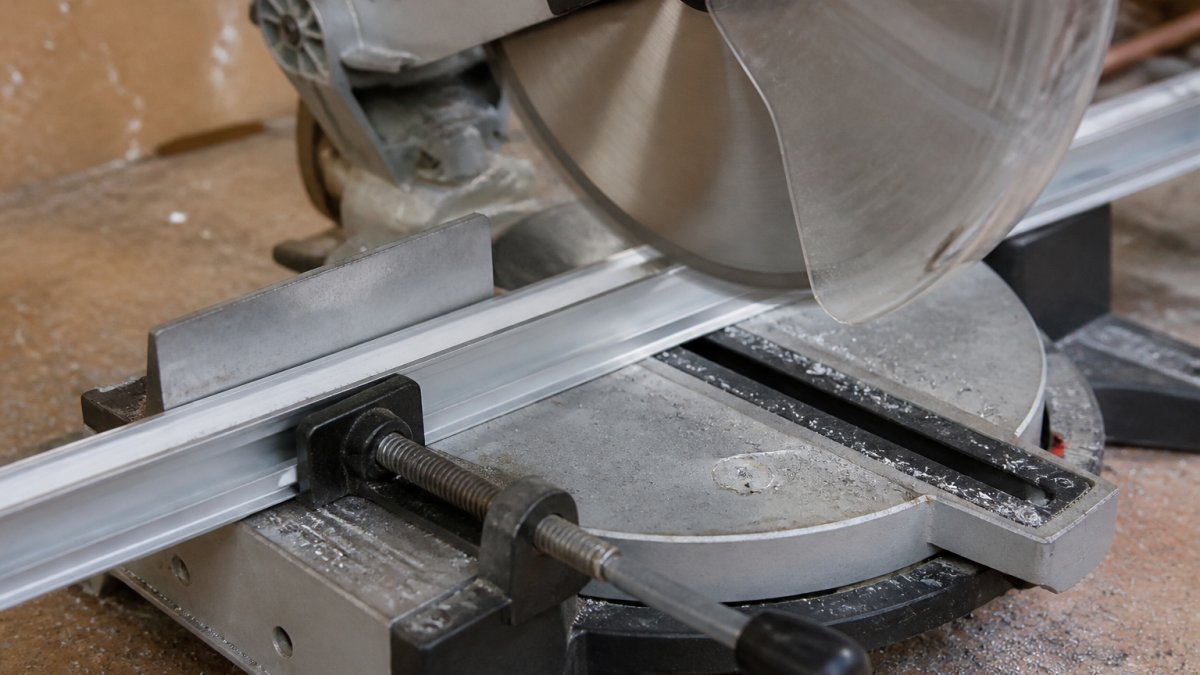
Setting Up a Mitre Cut
Work through this in order:
- Mark the cut line on masking tape stuck to the profile.
- Set the saw to 45 degrees and lock it.
- Clamp the profile flat, with the finished face down.
- Lower the blade slowly. Let the teeth cut, do not force it.
- Release the clamp only when the blade stops.
Watch out: cutting with the finished face up will scratch it as the swarf drags across the surface. Face down, every time.
For internal corners, both cuts go the same way. For external corners, one profile is cut at 45 degrees one way and its partner the opposite way. Check the dry fit before you commit.
How to Deburr Aluminium After Cutting
Deburring is the step most people skip, and it is the one that decides whether the finished job looks professional. A cut aluminium edge carries a fine burr that will catch a cloth, cut a finger, and stop trims sitting flush.
Here is the method we recommend:
- Run a half-round file along the cut edge at a shallow angle.
- Work in one direction, away from the finished face.
- Use light pressure. Aluminium files quickly.
- Finish with 240-grit paper wrapped round a block.
- Wipe the edge with a dry cloth.
Run a fingertip along the edge, carefully. If it feels smooth, you are done. If it catches, keep going. This takes two minutes and saves an hour of fiddling later when a trim will not clip on.
Common Mistakes When Cutting Aluminium Shower Profiles
A common mistake is rushing the clamp. A profile that shifts mid-cut ruins the angle, and you cannot fix a bad mitre by filing it.
Other common errors include:
- Using a coarse blade. It grabs the aluminium and leaves a ragged edge.
- Skipping the tape. Masking tape protects the finish and gives you a line to follow.
- Cutting the longest measurement. Walls are not square. Always use the shortest.
- Forgetting the expansion gap. Profiles need a couple of millimetres of room.
- Deburring after fitting. Do it before, while the profile is still on the bench.
If you want to avoid the wider set of errors that derail a bathroom project, our list of bathroom renovation mistakes to avoid covers the ones that cost the most time and money.
Ordering Profiles and Trims from Wetwall Wonders
Getting the profile right is half the job. The other half is having the matching trim ready so the installation can be completed without delay. You can find the External Corner Wall Trim White to finish the installation.
Wetwall Wonders offers a range of installation accessories, including trims. For current product details and availability, search the Wetwall Wonders website.
Frequently Asked Questions
Can you cut aluminium shower profiles with a hacksaw?
Yes, a hacksaw with a fine-tooth blade (32 teeth per inch) will cut aluminium shower profiles, though it takes longer and needs a steady hand to keep the cut square. Clamp the profile firmly and cut with light, even strokes to avoid bending the thin walls. A hacksaw works best for short trims or awkward angles where a power saw cannot reach. Finish with a fine file to remove burrs before fitting.
How do you prevent aluminium profiles from bending while cutting?
Support the profile along its full length and clamp it close to the cut line so the blade does not snag and twist the metal. Use a blade with a high tooth count and let the saw do the work rather than forcing it. For thin-walled shower profiles, pack the channel with a scrap of timber or fit a close-fitting offcut inside the hollow section to stop the walls collapsing as the blade passes through.
How do you get a clean, burr-free cut on an aluminium shower profile?
Cut with a fine-tooth blade at a slow feed rate, then run a flat file along the cut edge at a shallow angle to remove the raised burr. Finish with 120-grit abrasive paper wrapped around a block to smooth the edge without rounding the profile face. Wipe away swarf with a dry cloth before fitting, because trapped metal filings can scratch the panel surface and interfere with silicone adhesion.
How do you protect the finish when cutting shower profiles?
Leave any protective film on the profile until after cutting and deburring where possible, and mask the area either side of the cut line with low-tack tape. Cut on a clean, padded surface so the profile face does not pick up scratches from the bench. Peel the film back slowly at the end and wipe the profile with a soft cloth rather than an abrasive pad.
Cutting aluminium shower profiles rewards patience over speed. Clamp properly, cut at the right angle, deburr every edge, and the finish will look like it was fitted by a professional. Wetwall Wonders supplies the panels, profiles, trims, silicones and adhesives to complete the job in one order, with panel sizes from 250mm to 900mm to suit tight ensuites and full walls alike. Get started with Wetwall Wonders and finish your shower enclosure with a fit that lasts.


