
Chrome vs Black Wall Panel Trims: Which Finish to Pick
Last Updated: November 8, 2026
Quick Summary
Chrome trim reflects light and blends into pale panels and chrome fixtures, while black wall panel trims frame edges and add contrast with matte black showers and dark panels. Both come in 10 mm profiles at £12.00 per 2600 mm length, so choose by look, light and upkeep.
- Chrome shows water spots more clearly, while matte black hides them but shows dust.
- Match the trim to the dominant metal in mixed-metal bathrooms, not the accent finish.
- In dim or small rooms chrome raises perceived brightness; black can make them feel tighter.
- Avoid bleach, scouring pads and acidic descalers, which break down the coating on both finishes.
- Order all profiles in the same finish at once so the finish matches across the room.
Table of Contents
- Chrome vs Black Wall Panel Trims: The Quick Comparison
- How to Choose Bathroom Wall Panel Trims That Fit the Room
- Bathroom Wall Panels With Chrome Fittings: Where Chrome Wins
- Bathroom Wall Panels With Black Fittings: Where Black Wins
- How to Clean Black Bathroom Fittings and Chrome Trims
- Edge, Corner and Joint Trims: Finishing the Details
- Ordering Your Trims and Planning the Install
- Frequently Asked Questions
Chrome vs Black Wall Panel Trims: The Quick Comparison
Choosing between comparing chrome vs black wall panel trims comes down to one question: do you want the trim to disappear into the panel or stand out as a deliberate detail? Chrome reflects and recedes, blending with glass and light.
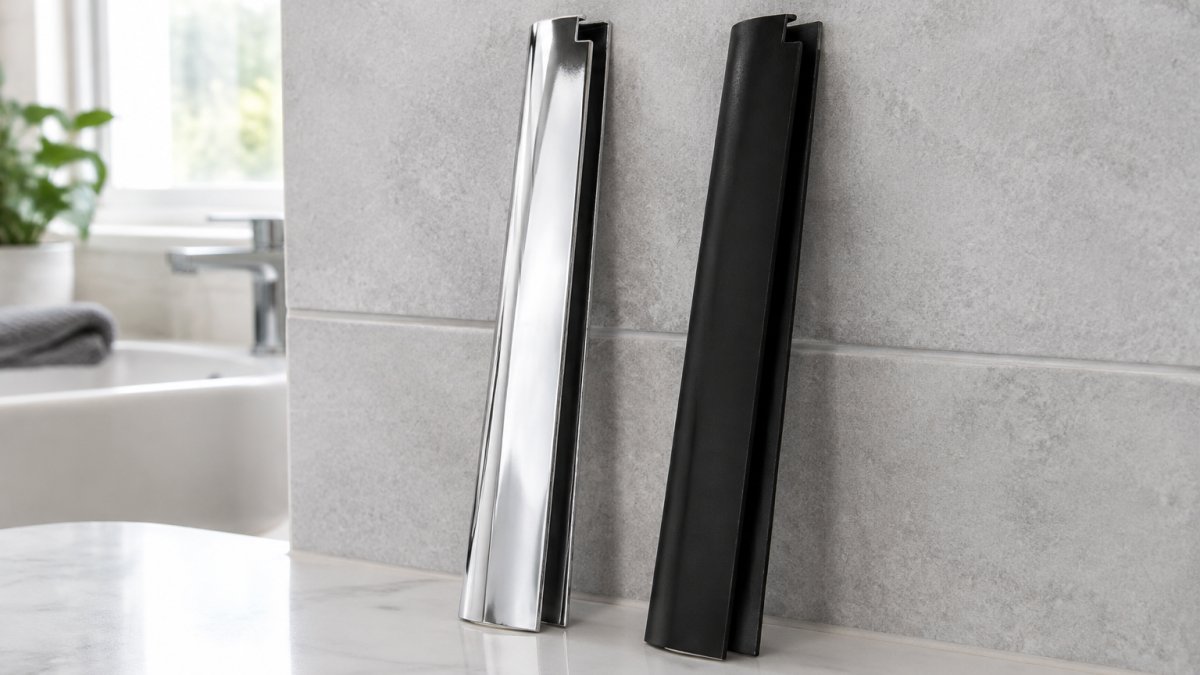
Here is the short version. Chrome suits bathrooms with chrome taps, shower screens and light tile-effect panels. Black wall panel trims suit darker fixtures, matte black showers and panels where you want visible structure.
| Factor | Chrome Trim | Black Trim |
|---|---|---|
| Best matched with | Chrome taps, glass screens, pale panels | Matte black showers, dark panels, industrial looks |
| Visual effect | Reflects light, blends in | Frames edges, adds contrast |
| Shows water spots | More visible | Less visible |
| Shows dust and residue | Less visible | More visible on matte surfaces |
| Cleaning care needed | Non-abrasive polish only | Damp cloth, mild soap |
| Price per 2600 mm | £12.00 | £12.00 |
How to Choose Bathroom Wall Panel Trims That Fit the Room
A common approach is to match the trim to your fixtures. That leaves the harder questions unanswered: what happens when your shower is chrome but your taps are black, or when the panel has a strong pattern that competes with a reflective finish? Work through the four checks below in order, because each one narrows the choice before the next.
Check 1: Fixture finish and metal tone
Start with the largest metal surface in the room, usually the shower valve or the screen frame. Chrome trim sits naturally beside polished chrome, polished stainless steel and glass. Black trim sits beside matte black, gunmetal and brushed brass, provided the black is a true matte rather than a gloss black that reads as plastic.
In mixed-metal bathrooms, the trim can be used to bridge two finishes. If the shower is chrome and the taps are black, a chrome trim keeps the reflective surfaces together and lets the black taps act as accents. Reversing that, black trim with a chrome shower and black taps, tends to make the chrome shower look isolated.
Check 2: Panel pattern and grout line colour
This is the detail most guides skip. Tile-effect panels with printed grout lines already contain a colour cue. If those lines are grey or charcoal, black trim extends the line and makes the wall read as a single design. If the lines are pale or white, chrome trim keeps the wall light and seamless.
Large-format panels with no grout line, marble effects, solid gloss, concrete, give you more freedom, but the panel's undertone still matters. Cool grey and blue-toned panels sit better with chrome. Warm stone, taupe and black panels sit better with black.
Check 3: Room size, natural light and ceiling height
Chrome reflects the room back at you, which raises perceived brightness and makes a small or north-facing bathroom feel less enclosed. Black absorbs light and draws the eye to the panel edges, which adds definition in a large room but can make a low-ceilinged or windowless space feel tighter.
A practical test is to stand in the doorway at the time of day you use the bathroom most. If the room already feels bright, black trim will not overwhelm it. If it feels dim even with the light on, chrome will do more work for you.
Check 4: Cleaning tolerance and household use
Be honest about how often you will wipe the trim. Chrome can show limescale, water spots and soap residue clearly, especially in hard-water areas, so a quick dry-down after showering helps it stay bright. Matte black hides water spots better but shows dust and fine residue on horizontal ledges and along the top edge of the trim.
In a busy family bathroom with children, matte black usually wins on day-to-day tolerance because water marks are less visible. In a spare or guest bathroom that is cleaned less often but used gently, chrome holds its look with minimal effort.
A quick decision guide
Use this sequence when you are stuck between the two:
- Small room, limited natural light, pale panels, chrome fixtures, choose chrome.
- Large room, good light, dark or patterned panels, matte black fixtures, choose black.
- Mixed metals, match the trim to the dominant metal, not the accent.
- Hard water and low cleaning tolerance, black hides water spots; chrome needs more frequent drying.
- Strong grout-line pattern, match the trim to the grout line colour for the cleanest result.
For the profile types that go with each finish, end caps, internal and external corners, H-trims, our shower panel trim and corner profiles guide sets out how each piece connects.
Bathroom Wall Panels With Chrome Fittings: Where Chrome Wins
Chrome wins when the room already has chrome. A chrome shower valve, a chrome riser rail and a glass screen all pull the eye, and chrome trim continues that line instead of interrupting it.
It also suits pale panels: white marble effects, light stone and gloss finishes all sit comfortably beside polished chrome.
The trade-off is upkeep. Chrome shows limescale and water spots clearly, particularly in hard water areas, and it needs wiping down more often than matte finishes. Abrasive cleaners will dull the coating, so stick to a damp cloth and a mild soap solution.
Bathroom Wall Panels With Black Fittings: Where Black Wins
Black wall panel trims win on contrast. Pair them with a matte black shower, black taps and a dark frame screen and the whole bathroom reads as one considered scheme rather than a collection of parts.
Black works especially well with dark tile-effect panels, concrete looks and slatwall designs, where the trim defines the panel edges instead of vanishing into them.
Where black falls short is dust. Matte surfaces show a fine film more readily than gloss, so a quick dry wipe every week keeps them looking sharp. Black also absorbs light, so in a small windowless ensuite it can make the space feel tighter.
How to Clean Black Bathroom Fittings and Chrome Trims
The finish on a wall panel trim is a coating, not the base material. On PVC trims, that coating is what gives chrome its reflectivity and black its matte depth. Most cleaning damage comes from the product, not the water, so the method matters more than the frequency.
Routine care for both finishes
Wipe down with a damp microfibre cloth and a mild soap solution after showering, then dry immediately with a second cloth. Drying is the step most people skip, and it is the one that prevents water spots from setting. Once a week, use a non-abrasive bathroom cleaner, rinse thoroughly with clean water, and dry again.
For chrome, a non-abrasive polish can restore shine if the surface looks dull, but apply it sparingly and buff off residue. For matte black, avoid polishes altogether, they can leave a sheen that ruins the matte effect. A damp cloth and mild soap are enough.
How water conditions affect each finish
Hard water leaves calcium deposits that show as white spots on chrome and as a pale film on matte black.
Soap residue and body oils behave differently. On chrome they smear and show as a dull haze. On matte black they collect in the fine texture and can look like a greasy patch.
Frequent shower use in a busy bathroom means the trim is exposed to steam, shampoo and conditioner splashes. Conditioner is particularly sticky and can leave a film that attracts dust. Wipe the lower sections of the trim, where splashes land, more often than the upper sections.
Coating quality and cleaner compatibility
Watch out: bleach-based sprays, scouring pads, wire wool and acidic descalers will break down the coating on both chrome and black PVC trims, leaving dull patches that cannot be polished out.
Check the cleaner's label before use. If it says not to use on plastics or coated surfaces, keep it away from the trims. If you are unsure, test a small area on an offcut or a hidden section first, and rinse immediately if the surface changes appearance.
Deep cleaning without damage
For a deeper routine that protects the panel surface as well, our guide on how to clean shower wall panels without damaging the finish sets out the full method. The same principles apply to trims: work from the top down, use the mildest product that does the job, rinse thoroughly, and dry. Never leave a cleaner to sit on the trim, and never mix cleaning products, the combination can be more aggressive than either product alone.
Edge, Corner and Joint Trims: Finishing the Details
Every installation may need more than one profile. An end cap closes a panel where it meets a door frame or wall. An internal corner joins two panels in a recess. An external corner wraps a protruding edge.
Seal every joint with a silicone rated for wet areas.
Order all profiles in the same finish at the same time so the finish matches across the room.
Ordering Your Trims and Planning the Install
Measure each run before ordering: panel edges, internal corners, external corners and joints. Add a little to each length for cutting, and remember trims are supplied at 2600 mm, so long runs may need joining.
Order everything in one go so the finish matches across the room. Our chrome end cap for 10 mm panels and black end cap for 10 mm panels both come in at £12.00, and the chrome internal corner matches them for a complete set.


Fit trims as you go rather than at the end. Panels need to sit fully into the profile, and retrofitting a corner trim after the adhesive has cured rarely gives a clean line.
The finish you choose will define how the whole bathroom reads, so match it to your fixtures before you order a single panel.
Frequently Asked Questions
Are black or chrome trims better for bathroom wall panels?
Neither is universally better; the room decides. Chrome suits bathrooms with chrome taps, shower frames and silver-toned panels, and it hides water spots less obviously on bright surfaces. Black wall panel trims suit dark fixtures, matte black showers and slate or charcoal panels, and they look sharper against white panels for contrast. Check your existing fittings first, then match the trim finish to them rather than picking a finish in isolation.
Do black wall panel trims show water marks?
Matte finishes can make water spots less noticeable than polished surfaces, depending on lighting. Both need wiping down after showering in hard-water areas. A quick microfibre pass after each use helps keep either finish looking clean.
Which trim finish works best with white bathroom wall panels?
Both work, but they create different effects. Chrome on white panels reads as a traditional, bright bathroom and blends with standard chrome taps and wastes. Black wall panel trims on white panels create a strong outline that suits modern and industrial schemes, and they pair well with matte black shower valves and handles. Decide whether you want the trim to disappear or to frame the panels, then match your fittings to that choice.
Can you mix black and chrome bathroom fittings?
Yes, and it is common in modern bathrooms, but keep the mix deliberate. Pick one finish as dominant, such as chrome taps with black trims, and repeat the secondary finish at least twice so it looks planned rather than accidental. Avoid splitting a single fixture group, like a shower valve and its riser, between the two finishes. Matching the trim to the smaller accent finish usually gives the tidiest result.
How do you clean black bathroom fittings without damaging the finish?
Use warm water with a small amount of mild washing-up liquid and a soft microfibre cloth, then dry the surface. Avoid abrasive pads and bleach-based sprays on coated black or chrome trims. For hard-water deposits, use a dedicated bathroom cleaner that states it is safe for coated finishes, and rinse it off fully rather than leaving it to sit.


