
High Gloss vs Matte Bathroom Wall Panels: Which Finish Wins?
Last Updated: November 6, 2026
Quick Summary
Choose high gloss bathroom wall panels for small, dim rooms because they reflect light and make the space feel larger, but expect visible water spots and fingerprints. Choose matte bathroom wall panels for family bathrooms, as they hide marks and need less wiping between cleans.
- Matte surfaces measure 5-7 Gloss Units, while high-gloss measures 90-100 GU.
- Gloss opposite a small window doubles daylight and makes the room feel wider.
- Clean both finishes with warm water, a soft cloth and mild detergent, never abrasives.
- Decorwall Maxi Panels are 10mm thick PVC, 100% waterproof, UV protected and UK fire rated with a 5 year guarantee.
- Gloss and matte Decorwall Maxi Panels both cost £59.00 at 2400mm x 900mm x 10mm.
Table of Contents
- High Gloss vs Matte Bathroom Wall Panels: The Quick Comparison
- How Light and Space Perception Differ Between Gloss and Matte
- Easy-Clean Bathroom Wall Panels: Which Finish Really Saves You Time?
- How to Clean Bathroom Wall Panels Without Damaging the Surface
- Bathroom Wall Panels for Small Bathrooms: Making the Right Choice
- Durability, UV Resistance and Long-Term Appearance
- Choosing Your Finish at Wetwall Wonders
- Frequently Asked Questions
High Gloss vs Matte Bathroom Wall Panels: The Quick Comparison
Comparing high gloss vs matte bathroom wall panels comes down to one trade-off: gloss reflects light and hides nothing, while matte absorbs light and forgives everything. At Wetwall Wonders, we sell both finishes in the same panel sizes and materials, so we have no reason to push you toward one. The difference is measured in Gloss Units (GU): matte surfaces sit at 5-7 GU, high-gloss at 90-100 GU, according to Protex Flooring's technical specification on surface reflection levels.
Here is the short version. Choose gloss if your bathroom is small and dark, and you want a polished, reflective surface that bounces light around. Choose matte if you want a modern, softer aesthetic, fewer visible fingerprints, and a surface that tolerates water spots between cleans.
| Feature | High Gloss | Matte |
|---|---|---|
| Light reflection | High, brightens small rooms | Low, diffuses light |
| Water spots and marks | Show clearly | Hide well |
| Fingerprints | Very visible | Barely visible |
| Best for | Compact, dim bathrooms | Busy family bathrooms |
| Cleaning effort | Higher, needs wiping after showers | Lower, tolerates neglect |
That table is the honest summary. Everything below explains the reasoning, so you can pick the right finish rather than the one that photographs best. If you want a wider view of finish selection before committing, our guide on how to choose the right bathroom wall panel finish covers the full range of options.
How Light and Space Perception Differ Between Gloss and Matte
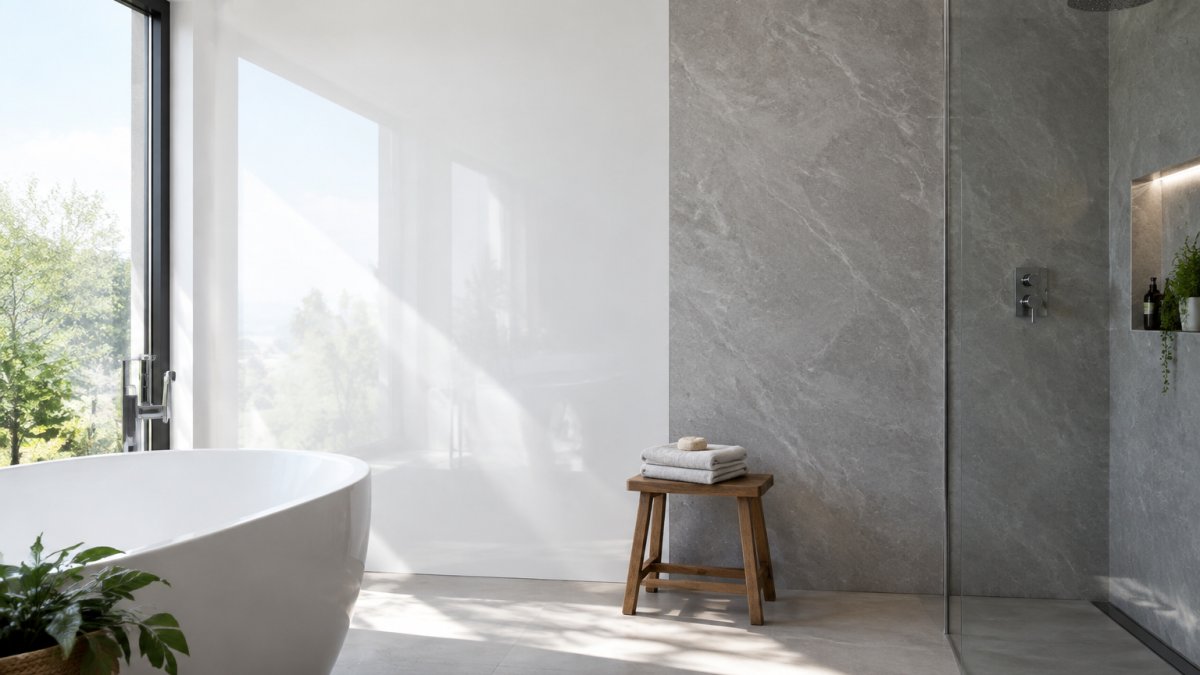
Gloss wins on light. A high-gloss panel acts like a mirror for daylight and artificial light, which is why Showerwall's guidance on reflective finishes notes that gloss surfaces are used to make smaller bathrooms feel larger. In a narrow ensuite with one small window, a gloss white panel can genuinely change how big the room feels.
Matte does the opposite, and that is the point. It diffuses light rather than bouncing it, producing a soft, even wash across the wall with no hot spots. The room reads calmer and more organic. It will not feel bigger, but it will feel less clinical.
Cool-white LED downlights (around 4000K) with a narrow beam. Gloss panels reflect the fitting as a hard, bright pool and can double the apparent number of downlights, which makes a small room feel busier. Matte spreads that same output into a soft wash and removes the hot spots. If you have a grid of four or more cool-white downlights, matte is usually the calmer choice.
Warm-white lighting (around 2700-3000K). Gloss picks up the warmth and bounces it, which can make a gloss white panel read cream or slightly yellow in the evening. Matte holds the colour temperature more faithfully because it is not mirroring the source. If colour accuracy matters next to a painted ceiling or tiles, matte is more predictable.
Diffused or indirect lighting (LED strips, backlit mirrors, ceiling wash). Gloss performs well here because there is no single bright source to reflect; the panel lifts the whole room. Matte still works but loses some of the brightness benefit. In a windowless room relying on a backlit mirror, gloss gives you more usable light.
Natural daylight from one small window. Gloss opposite the window doubles the daylight and makes the room feel wider. Matte opposite the window softens the glare but does not extend the perceived space. If the window is the only source, gloss on the wall facing it is the higher-impact choice.
Mixed lighting. A common pattern is gloss on the wall that receives the most daylight and matte on the wall behind the shower where downlights hit directly. This gives you the space-stretching bounce without the reflected hot spots.
Watch out: a gloss panel directly beneath a close-mounted downlight will show the fitting's reflection at eye level, which some people find distracting; check the reflection line from a seated and standing position before fixing.
If you are weighing finish against layout, our modern bathroom designs for small spaces guide shows how panel size and finish work together under different lighting plans.
Easy-Clean Bathroom Wall Panels: Which Finish Really Saves You Time?
Matte saves time. That is the blunt answer, and it surprises people who assume the smoother surface is easier to wipe.
Gloss shows everything: water spots, soap scum, toothpaste flecks, and the streaks left by a damp cloth. Kraftersland's comparison of gloss and matte finishes reports that glossy surfaces show water spots and soap scum more prominently than matte alternatives, so they need more frequent cleaning to stay pristine.
A matte finish hides the same mess. Drips and marks dry without the hard edges that catch light, and fingerprint resistance is far better. Neither finish is self-cleaning, and both need a routine, but the matte panel will look presentable for longer between cleans. For a family bathroom used twice a day, that difference is worth more than any aesthetic argument.
How to Clean Bathroom Wall Panels Without Damaging the Surface
Clean both finishes the same way: warm water, a soft cloth, and a mild detergent. Never use abrasive pads, scouring cream, or bleach-heavy sprays, because they dull the surface layer and, on gloss, leave permanent scratch haze.
Our step-by-step routine:
- Rinse the wall with warm water after showering to stop soap scum setting.
- Wipe with a soft microfibre cloth and a mild washing-up liquid solution.
- Work top to bottom so drips do not streak dried panels.
- Dry gloss panels with a second cloth to prevent water spotting.
- Use a silicone squeegee on gloss weekly; skip it on matte.
- Avoid abrasive cleaners and anything labelled "scratch resistant" on the bottle.
Watch out: leaving neat bleach or descaler on any panel can stain the surface layer, and the damage is not covered by a guarantee. For the full method, read our guide on how to clean shower wall panels without damaging the finish.
Bathroom Wall Panels for Small Bathrooms: Making the Right Choice
For a small bathroom, gloss is usually the better pick. The reflective surface increases perceived space, and a light gloss tone, such as white or antique marble, keeps the room from feeling boxed in.
Matte still works in tight rooms, but use it as a contrast rather than the whole wall. A matte stone-effect panel behind the shower paired with a gloss panel on the opposite wall gives you softness without losing the light bounce. Narrow panels help here too: our 250mm Decorwall Classic range suits tight alcoves where a 900mm panel would waste cuts.
If you are planning the layout as well as the finish, our modern bathroom designs for small spaces guide shows how finish and panel size work together in compact rooms.
Durability, UV Resistance and Long-Term Appearance
Both finishes last, provided the panel itself is built for a wet room. The Decorwall Maxi Panels are 10mm thick PVC, 100% waterproof, UV protected, and UK fire rated, with a 5 year guarantee. That construction matters more than the finish.
Where the two diverge is long-term appearance. Gloss has a smooth, highly reflective surface, so fine scratches or cleaning haze are more likely to show, while matte tends to hide the same marks more easily.
Sunlight can affect colour over time, and the panel's UV protection is the main safeguard against that, whichever finish you choose.
Watch out: not all PVC panels carry the same protection, so check the UV protection stated on the product listing rather than assuming all panels are equal.
Scratch resistance is a separate axis. Gloss surfaces show fine scratches from abrasive cloths and grit, so avoid scouring pads and always rinse before wiping. Matte surfaces hide scratches but can trap dirt in the texture if cleaned with a dry cloth; a damp microfibre cloth lifts it without polishing the surface.
If longevity in a busy bathroom is your priority, our roundup of durable wetwall panel options for high traffic bathrooms is the place to compare specifications, including UV ratings and surface guarantees.
Choosing Your Finish at Wetwall Wonders
We stock both finishes, so the decision is yours to make on merit. Our gloss options include the Decorwall Maxi Panel in Gloss White at £59.00 and the Gloss Antique Marble at the same price, both 2400mm x 900mm x 10mm. For matte, the Decorwall Maxi Panel in Matt Carrera costs £59.00 in the same size. Narrower walls suit the Decorwall Classic range, with gloss and matte white panels at £11.00 each.


Best for gloss: small, dim bathrooms that need more light and a polished effect. Skip gloss if: you want a low-maintenance wall you can leave between cleans.
Best for matte: family bathrooms, soft modern schemes, and anyone tired of wiping streaks. Skip matte if: the room is windowless and needs every bit of reflected daylight.
The finish you choose will outlast the trend that inspired it, so pick for how you actually use the room, not how it looks in a showroom photo. Wetwall Wonders supplies both finishes in matching sizes, along with the adhesives, silicones, and trims to complete the job in one order, so you are not chasing parts mid-install. Browse the range, match your panel width to your wall, and get the finish that suits your bathroom rather than the other way round.
Frequently Asked Questions
Are high-gloss or matte bathroom wall panels easier to clean?
Matte panels are generally more forgiving day to day. High-gloss surfaces show water spots, soap scum and fingerprints more clearly, so they need wiping more often to stay pristine. Matte finishes hide these marks better between cleans. Either way, a quick wipe with a soft cloth and mild detergent keeps both finishes in good condition, and both are far easier to maintain than tiled walls with grout lines.
Do glossy bathroom wall panels make a small bathroom look bigger?
Yes, gloss finishes reflect light around the room, which can make a compact bathroom feel more open. That said, matte panels in light colours also create a sense of space without the reflective glare. For small bathrooms, the colour and panel size often matter as much as the finish. Large-format panels such as the 900mm Decorwall Maxi range reduce visible seams, which helps a tight room feel less busy.
Do matte bathroom wall panels show water marks?
Matte panels hide water marks and dried drips better than gloss because the surface scatters light rather than reflecting it. On a high-gloss panel, every dried droplet catches the light. On a matte finish, the same mark is far less visible. Neither finish is immune to limescale in hard-water areas, so a regular cleaning routine still matters, but matte gives you more visual tolerance between cleans.
Can you mix matte and gloss finishes in a bathroom?
Mixing finishes works well when there is a clear logic to it. A common approach is gloss inside the shower enclosure to bounce light around a dark corner, with matte panels on the surrounding walls for a softer look. Keep the colour palette consistent so the contrast reads as deliberate. Using the same panel range, such as Decorwall Maxi in 900mm widths, makes it easier to match tones across both finishes.
Which finish is better for a shower, gloss or matte?
Both work in a shower when the panels are fully waterproof, as the Decorwall Maxi range is. Gloss reflects light and suits smaller or darker shower areas, but it shows soap scum more readily. Matte hides water spots and feels warmer underfoot in design terms, though it needs a routine wipe-down to stop limescale building up. Choose gloss for brightness, matte for lower maintenance between cleans.


