
Wetwall Works Alternatives for Contractors in 2026
Table of Contents
- Why Contractors Are Switching from Wetwall Works
- Cost Comparison Wall Panels vs Tiles: The Contractor's View
- Hardex Solid Wall Panels: The Durable Workhorse
- Dumawall+ High Gloss: A Direct Wetwall Works Alternative
- Kerradeco and Decorwall: Specialist Finishes for High-End Fits
- Waterproof Wall Panel Installation Guide: Prep to Finish
- Where to Buy Bathroom Wall Panels Online UK: A Supplier Checklist
- Conclusion: Matching the Panel to the Project
- Frequently Asked Questions
Last Updated: September 6, 2026
Why Contractors Are Switching from Wetwall Works
A wetwall works alternative must deliver on reliability, technical consistency, and cost-per-square-meter.
At Wetwall Wonders, we supply panels to independent bathroom fitters, interior designers, and small-scale contractors across the UK. The best alternative to any single brand is a supplier carrying multiple professional-grade systems, so you can match the panel to the substrate, budget, and deadline.
Cost Comparison Wall Panels vs Tiles: The Contractor's View
For a contractor, the cost comparison wall panels vs tiles is not a simple material price check. It is a calculation of your day rate, crew productivity, and the cost of a callback.
The Labour Rate Reality
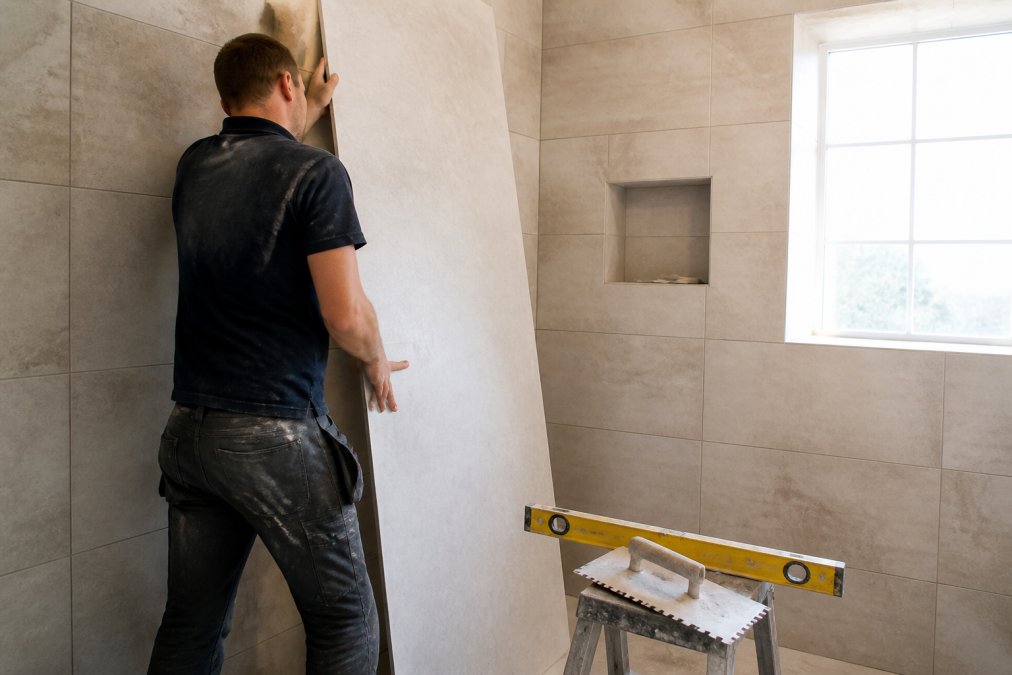
Consider a standard 4 m² bathroom wall. With traditional tiling, a skilled fitter spends two to three days on prep, fixing, grouting, and sealing. At a UK day rate of £200-£250, that is £400-£750 in labour before materials. With large-format panels (e.g., 2.4 m x 1.2 m boards), the same area can be boarded and sealed in 4-6 hours, a labour cost of roughly £100-£150.
The Hidden Cost of Callbacks
Grout failure can be a cause of callbacks in tiled bathrooms. Each callback costs fuel, time, and reputation. Panels eliminate grout lines entirely, removing that failure mode. Avoiding grout-related callbacks can offset the higher material cost of panels.
Material Waste and Skip Costs
Tiling generates offcuts, broken tiles, and bagged adhesive waste that often requires a skip or multiple tip runs. Panels produce minimal waste, a few offcuts usable for smaller areas. On a five-bathroom development, skip savings alone can be £100-£200.
The ROI Angle for Commercial Contractors
For commercial contractors, the business case is scalability. If a two-person team completes a bathroom in one day with panels versus four days with tiles, your crew can complete four times the fit-outs per month. The material premium is absorbed by the labour saving on the first bathroom.
| Cost Factor | Traditional Tiling | Wall Panels | Contractor Impact |
|---|---|---|---|
| Material cost per m² | £20-£50 (ceramic) | £35-£70 (composite) | Panels cost more, but... |
| Labour time per 4 m² wall | 2-3 days | 4-6 hours | Frees a full day per bathroom |
| Labour cost at £225/day | £450-£675 | £112-£168 | Saves £300-£500 per bathroom |
| Grout and sealant | Required (adds £50-£80) | Not needed | Removes a consumable cost |
| Callback risk | Higher (grout failure) | Lower | Fewer unpaid return visits |
| Waste disposal | Skip required | Minimal | Saves £100-£200 on multi-bathroom jobs |
Hardex Solid Wall Panels: The Durable Workhorse
For commercial projects and high-traffic residential bathrooms, the Hardex Solid Wall Panel is our top recommendation. Constructed from durable wood plastic composite and available in eight colours, this flush square edge panel withstands impact and daily wear. At 2.4 m by 1220 mm, it covers large areas quickly.

Hardex panels are priced at £126.00 per panel and work well in bathrooms, kitchens, and wet rooms. The solid construction gives impact durability that thinner PVC alternatives cannot match. A solid composite panel like Hardex needs a flat, sound wall to perform correctly.
Dumawall+ High Gloss: A Direct Wetwall Works Alternative
The Dumawall+ High Gloss range is a heavy-duty PVC alternative to ceramic tiles and the closest direct wetwall works alternative in our catalogue. Sold in packs of eight at £3.95 per panel, these boards deliver the bright shine of glazed tiles without grout lines. Each panel measures 65 cm by 37.5 cm with 5 mm thickness; a pack covers 1.95 m².

What makes Dumawall+ stand out is the micro grout line, a visible grout effect moulded into the PVC, so there is nothing to crumble or discolour. These panels are 100% waterproof, UV-resistant, and colourfast, with high impact resistance for humid areas.
Installation Speed and the Tongue and Groove System
The Dumawall+ range uses an easy-connect tongue and groove design that lets panels click together, and they can be fixed with adhesives, nails, or staples.
The 10-year manufacturer's warranty on Dumawall+ is a selling point when specifying for a rental property or developer client.
Kerradeco and Decorwall: Specialist Finishes for High-End Fits
For high-end residential work, the Kerradeco Stone Grey panels deliver the look of natural stone or marble without the weight and complexity. Made from premium PVC, they are 100% waterproof and hygienic. Each pack of eight covers 3.186 m², with panels measuring 1350 mm by 295 mm by 9 mm. At £209.00 per pack, they sit at the premium end, but the finish justifies the cost for client-facing projects.

The Decorwall Elegance Mineral-Calcite Wall Panel offers a similar premium finish at a more accessible price point. At £22.00 per single panel with a 300 mm width and 8 mm thickness, it works well as a feature wall or for smaller spaces.
Waterproof Wall Panel Installation Guide: Prep to Finish
A proper waterproof wall panel installation guide for contractors starts with substrate compatibility, not just surface cleaning.
Substrate Compatibility: What You Can and Cannot Board Over
Different panel types demand different substrates. Here is the practical breakdown:
- Solid composite panels (e.g., Hardex, WPC-based): These are heavy, typically 8-12 kg per m². They require a sound, flat substrate capable of bearing that weight. Plasterboard is acceptable if it is dry and fixed at 300 mm centres. Uneven plaster or old tile surfaces must be levelled or overboarded with 9 mm ply or moisture-resistant plasterboard before fixing.
- Thin PVC panels (e.g., Dumawall+, 5 mm thickness): These are lighter and more forgiving, but they will telegraph every surface imperfection. A straightedge check across the wall is non-negotiable. If you find more than a 2 mm gap under a 1 m straightedge, you need to level the wall or the panel will show a visible ripple in reflected light.
- Mineral-calcite panels (e.g., Decorwall): These are rigid and brittle compared to PVC. They need a perfectly flat substrate and must not be flexed during installation. Overboarding with ply is the safest route for these panels.
Tooling and Accessory Requirements
Here is the minimum kit for a professional panel installation:
- Cutting: A fine-tooth circular saw (60-80 teeth) or a track saw for straight cuts. A sharp utility knife with a straightedge works for thin PVC (up to 5 mm), but for composite or mineral panels, a saw is mandatory. Do not use a jigsaw for long cuts, it will wander and chip the edge.
- Adhesive: Use a panel-specific adhesive (e.g., GripFill or similar solvent-free grab adhesive) applied in vertical ribbons of 10-12 mm diameter, spaced at 150-200 mm intervals. Do not dot and dab; full ribbons prevent hollow spots that flex and crack panels over time. For heavy composite panels, check the adhesive's open time, some need the panel pressed within 10 minutes of application.
- Sealant: A sanitary silicone sealant (fungicidal, neutral-cure) for all joints, edges, and the base of the panel. Use a high-modulus silicone for wet areas. Acetoxy-cure silicones can corrode some metal trims, check compatibility.
- Spacers: 2-3 mm spacers at floor and ceiling to allow for thermal expansion. Panels expand and contract with temperature changes; rigid fixing at both ends will cause bowing.
- Trims and profiles: Internal and external corner trims, edge caps, and finishing profiles. These are not optional, they protect the cut edges from moisture ingress and give a professional finish.
The Fixing Sequence That Prevents Callbacks
- Check flatness with a 1 m straightedge. Mark any high or low spots.
- Level the substrate if needed. For plasterboard, fill low spots with a suitable filler. For old tiles, either remove them or overboard with 6-9 mm ply.
- Dry-lay the first row to plan your cuts and ensure the panels are square to the room.
- Apply adhesive in vertical ribbons. For tongue and groove systems, apply adhesive to the wall, not the panel, then click the panels together working from a corner outward.
- Press and hold each panel for 30-60 seconds. Use a temporary brace or batten if the panel is heavy.
- Fit spacers at floor and ceiling.
- Seal all edges with sanitary silicone, including the base, the top edge, and around any pipe penetrations. This is the step most installers rush, and it is the step that causes 90% of moisture failures.
- Allow 24 hours for adhesive and sealant to cure before exposing the panels to water.
Fire Ratings and Compliance
For commercial projects, you need to know what you are fixing to the wall. Most PVC panels carry a fire classification of Class B-s1, d0 under EN 13501-1 (europa.eu). However, for escape routes, high-rise buildings, or buildings with specific fire strategies, you may need panels with a higher classification (e.g., Class A2 or B-s1, d0 with lower heat release). Check the manufacturer's technical data sheet before specifying. The UK government's guidance on construction product compliance sets out the requirements for construction products in the UK, and your supplier should be able to provide the relevant test certificates on request.
The Expansion Gap You Cannot Skip
Panels expand and contract with temperature and humidity changes. A 2.4 m panel can move 1-2 mm across its width in a bathroom environment. If you fix panels hard against the ceiling or floor without a 2-3 mm expansion gap, the panels will bow or buckle. The gap is hidden by the silicone sealant, so there is no aesthetic downside. Skipping it is the fastest way to create a warranty claim.
Get the substrate, adhesive, and sealing right, and you deliver a surface that outperforms tiles on speed and maintenance.
Where to Buy Bathroom Wall Panels Online UK: A Supplier Checklist
When deciding where to buy bathroom wall panels online UK, the supplier matters as much as the product. Check the following before placing an order:
- Stock consistency: Can the supplier guarantee the same batch and finish across multiple orders?
- Full system availability: Do they stock the panels, adhesives, silicones, and trims together, or will you be ordering from three different places?
- Delivery reliability: What is their lead time, and do they notify you of backorders before you commit?
- Warranty clarity: What does the manufacturer's warranty actually cover, and for how long?
- Technical support: Can they answer questions about substrate preparation and adhesive compatibility?
The UK government's guidance on construction product compliance sets out the standards that wall panels and cladding materials must meet for use in buildings.
Conclusion: Matching the Panel to the Project
The right wetwall works alternative for contractors depends entirely on the project. For commercial fit-outs and high-traffic areas, the Hardex Solid Wall Panel delivers the impact durability you need. For quick turnarounds on residential bathrooms, Dumawall+ High Gloss gives a tiled look without grout maintenance. For premium client work, Kerradeco and Decorwall provide natural finishes that justify a higher day rate.
What every contractor needs is a supplier that stocks the full system, from panels to adhesives to sealants. Wetwall Wonders carries panel sizes from 250 mm up to 900 mm widths, including Dumawall tile effects and Linerio slatwall, plus all installation accessories. That simplifies procurement and keeps your project on schedule.
Get started with Wetwall Wonders and find the wall panel system that matches your next project's budget, timeline, and finish requirements.
Frequently Asked Questions
What is the best Wetwall Works alternative for contractors?
The best Wetwall Works alternative depends on the project. For high-impact commercial fit-outs, the Hardex Solid Wall Panel provides a durable wood plastic composite core. For residential bathroom renovations where a high-gloss finish is needed, the Dumawall+ range is a direct alternative, offering 100% waterproof PVC with a 10-year warranty. Kerradeco and Decorwall offer specialist finishes for premium projects.
Are wall panels more cost-effective than tiles for contractors?
Yes. The cost comparison wall panels vs tiles favours panels when labour is factored in. Tiling requires substrate prep, adhesive, grouting and sealing, which extends project turnaround. Wall panels install faster with adhesive bonding, reducing labour cost per square metre, improving your margins.
How do I install waterproof wall panels correctly?
Start with substrate preparation: walls must be flat, dry and structurally sound. Mark your cut lines and use a fine-tooth saw for clean edges. Apply a suitable adhesive in vertical beads, then fix the panel using the tongue and groove system to lock boards together. Use a sealant compatible with PVC panels at all joints and corners. Finally, fit trims to create a seamless, moisture-resistant finish.
Are wall panels faster to install than ceramic tiles?
Yes, installation is significantly faster. A standard shower enclosure can be panelled in a day, whereas tiling requires multiple visits for adhesive drying and grouting. Panels eliminate the need for precise tile levelling and grout lines. This speed reduces labour costs and allows contractors to take on more projects.

