
7 Best Modern Bathroom Vanity Ideas for 2026
Table of Contents
- Why Modern Bathroom Vanity Design Has Shifted in 2026
- Floating Vanities and Wall-Hung Cabinetry
- Modern Bathroom Designs for Small Spaces
- How to Install a Bathroom Vanity: A Step-by-Step Guide
- Bathroom Vanity Material Durability: What Actually Lasts
- Colour, Finish and Hardware Trends for 2026
- Storage, Lighting and Spa-Style Details
- Conclusion
- Frequently Asked Questions
Last Updated: September 19, 2026
Why Modern Bathroom Vanity Design Has Shifted in 2026
The modern bathroom vanity has moved from heavy, floor-mounted cabinetry toward wall-hung units, warm wood tones and matte finishes that make small rooms feel larger. This guide from Wetwall Wonders breaks down seven ideas worth copying this year.
Floating Vanities and Wall-Hung Cabinetry
Floating vanities are the most requested style this year. A wall-hung unit sits clear of the floor, making even a narrow bathroom feel more open and the floor easier to clean.
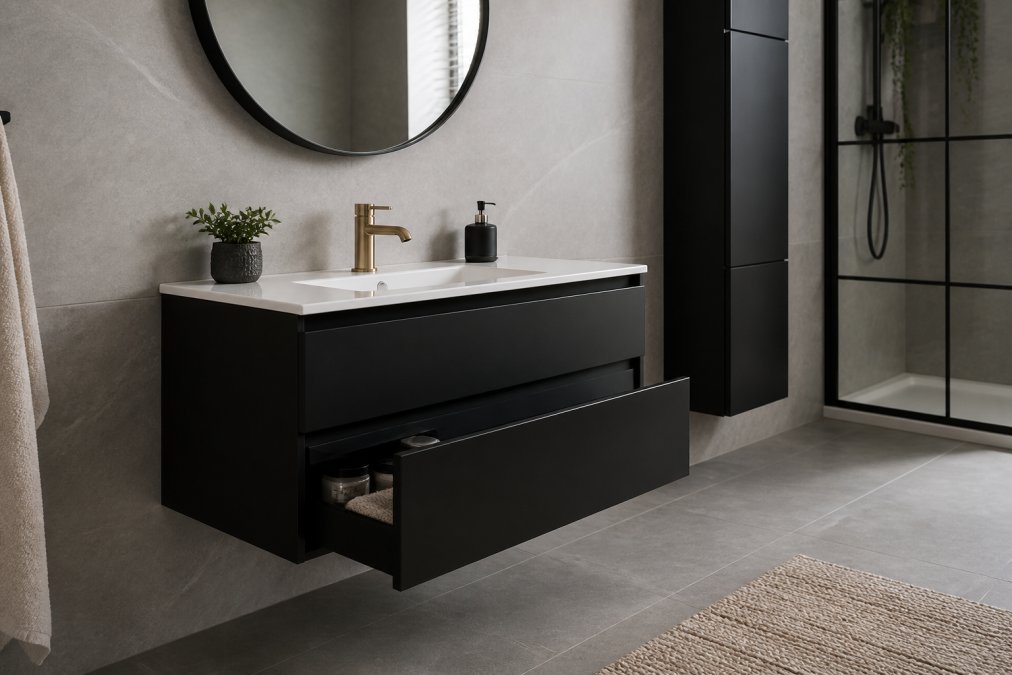
Modern Bathroom Designs for Small Spaces
Small bathrooms reward restraint. A compact vanity with a single drawer and an integrated basin usually beats a wider unit with open shelving, because closed storage keeps the room calm and clutter-free.
Compact Units That Fit Tight Layouts
- Narrow basin units (410mm to 510mm): best for ensuites and box rooms
- Wall-hung designs: keep the floor clear and make the room feel wider
- Integrated basins: remove the gap between basin and counter, so there is less to clean
- Soft-close drawers: quieter and kinder to the unit over time
| Vanity Type | Space Needed | Best For | Watch Out For |
|---|---|---|---|
| Wall-hung (floating) | Clear floor beneath | Small rooms, easy cleaning | Needs a solid wall fixing |
| Floor-standing | Full floor footprint | Uneven walls, heavy storage | Takes up more visual space |
| Compact 410mm-510mm | Narrow alcove or corner | Ensuites, box rooms | Limited counter space |
| Dresser-style | Wider wall run | Larger bathrooms, storage | Needs more clearance |
How to Install a Bathroom Vanity: A Step-by-Step Guide
Total time: 2 to 4 hours for a straightforward swap, longer if you are moving pipework.
What You'll Need Before You Start
- Your new vanity unit and basin
- A spirit level
- A drill with the correct wall fixings for your wall type
- Silicone sealant and a silicone gun
- Adjustable spanner and a screwdriver set
- A helper for lifting wall-hung units
- Old towels and a bucket for any residual water
Step 1: Isolate the Water and Remove the Old Unit
Turn off the water supply and drain the trap into a bucket. Disconnect the supply pipes and remove the old basin and unit.
Step 2: Check the Wall and Mark Your Height
Hold the unit against the wall at your chosen height and mark the fixing points. Use a spirit level to confirm it is straight before drilling.
Step 3: Fix the Unit and Connect the Plumbing
Secure the unit with fixings suited to your wall, then reconnect the waste and supply pipes. Check every joint for leaks before you seal anything.
Step 4: Seal and Finish
Run a continuous bead of silicone where the unit meets the wall, then smooth it with a silicone tool. Leave it to cure before use.
Common Mistakes to Avoid
- Sealing before testing. Run water through the waste first, then seal once you know it is dry.
- Skipping the wall check. A hollow or stud wall needs different fixings to solid masonry.
- Using too little silicone. A thin or broken bead lets water track behind the unit.
- Ignoring the trap height. If the waste outlet sits too high, water will not drain properly.
Bathroom Vanity Material Durability: What Actually Lasts
Bathroom vanity material durability comes down to how well a surface handles standing water, steam and cleaning products, and how it was sourced. The useful question is what it will look like in five years.
Cabinet bodies: what survives daily steam
Moisture-resistant MFC with a lacquered or foil-wrapped finish, as used on several units in the Cosmos and Vista ranges, resists swelling at the edges when sealed properly. The weak point is never the panel face, it is the cut edge. If the edge banding lifts or the silicone bead at the back fails, water tracks into the core and the board swells permanently, which is why a continuous, well-cured silicone seal matters more than the panel spec.
Worktops and basins: the trade-offs
| Surface | Handles water | Maintenance | Watch out for |
|---|---|---|---|
| Natural stone (marble, granite) | Good once sealed | Re-seal every 6-12 months | Acidic cleaners etch marble |
| Terrazzo | Very good | Wipe-down, occasional re-seal | Can chip at edges |
| Ceramic / vitreous china | Excellent | Wipe-down only | Chips if knocked hard |
| Solid surface | Excellent | Light abrasive restores it | Heat marks from hot tools |
Ceramic and vitreous china basins, like those in the Vista range, are the most forgiving: non-porous, easy to wipe down and unaffected by most bathroom cleaners. Natural stone and terrazzo look striking but need sealing and careful cleaning, abrasive or acidic products dull the surface and strip the sealer fast.
Eco-friendly and low-VOC sourcing
Most 2026 round-ups are silent on this, and it is worth asking before you buy. Look for:
- Low-VOC and water-based lacquers on cabinet bodies, better indoor air quality in a small, poorly ventilated room.
- FSC-certified timber for wood finishes, so the veneer or solid stock is traceable.
- Recycled or bio-based content in terrazzo and solid-surface tops, which increasingly use recycled glass or aggregate.
- Repairability, a solid-surface top that can be sanded back beats a sealed veneer that cannot.
Finish matters as much as material
Matte finishes hide water spots and fingerprints far better than high gloss, which is one reason they dominate 2026 interiors. But matte surfaces can be harder to clean without leaving a sheen mark, so use a pH-neutral bathroom cleaner and a soft cloth rather than an abrasive cream. For the long version on how damp behaves in a bathroom and which surfaces cope, see our guide to which bathroom wall and surface finishes cope with moisture.
Colour, Finish and Hardware Trends for 2026
Sage green, navy and charcoal dominate this year's palettes, usually paired with warm wood tones or a crisp white basin to stop the room feeling dark, with matte finishes the default across cabinetry and taps. The difference between a scheme that works and one that dates quickly is how cabinet colour, worktop/basin and hardware are balanced.
The 2026 palettes, and how to use them
- Sage green: calm and spa-like. Works best with warm wood, brushed brass and a white ceramic basin. In a small room, keep it to the vanity and leave the walls light.
- Charcoal: the most forgiving of the dark tones because it hides water marks. Pair with a pale worktop so the room does not close in.
- Navy: strong contrast against white ceramics. Best on a single wall or a freestanding unit rather than a full run of cabinetry.
- Warm neutrals (latte, oatmeal): the safe, resale-friendly choice, and the easiest to match to existing tiles.
A useful rule for small bathrooms: one dark element, everything else light. Two dark surfaces in a compact room make it feel smaller, not more dramatic.
Hardware: the detail that dates fastest
Brass hardware is the standout detail, particularly against dark units, where it adds warmth without looking dated; matt black runs a close second. The practical point most guides skip is finish durability:
- Brushed brass and brushed nickel hide fingerprints and water spots well and wear evenly.
- Polished chrome is the most hard-wearing but shows every mark.
- Matt black looks sharp but can chip at the edges of handles over time; powder-coated finishes generally outlast painted ones.
- Keep one metal family across taps, handles and mirror frame. Mixing three metals is the fastest way to make a new bathroom look dated.
Lighting changes the colour you chose
A colour that looks right in a showroom can look muddy at home because bathroom lighting is usually cooler and dimmer than retail lighting. Warm white bulbs (around 2700-3000K) flatter sage, wood and brass; cooler light (4000K and above) suits charcoal and white schemes but makes warm tones look grey.
Matching the walls to the vanity
If you are refreshing the walls at the same time, Wetwall Wonders stocks panels in 250mm, 300mm, 500mm and 900mm widths, including Dumawall tile effect and Linerio slatwall, so you can match the wall finish to your vanity colour. A warm wood slatwall behind a sage or charcoal unit is one of the most requested combinations this year, and it hides the uneven walls common in older properties without a full re-tile.
Storage, Lighting and Spa-Style Details
For a full bathroom refresh rather than a vanity swap alone, the Vista Full Suite with Bath at £550.00 bundles a 560mm basin unit, a rimless close coupled WC, a 1700x700x400mm bath with front panel, and chrome fittings, with a lifetime ceramics guarantee and 20 years on the bath.

Conclusion
Choosing the right vanity means matching storage, material and lighting to the room you actually have, not the showroom photo. Get the wall fixing and the silicone seal right, and the rest is straightforward.
Frequently Asked Questions
What are the bathroom vanity trends for 2026?
Floating and wall-hung units remain the dominant style, paired with matt finishes in black, latte and anthracite. Brass and matt black hardware, integrated basins and soft-close drawers are standard on contemporary packs. Warm wood tones and natural stone or terrazzo countertops balance the clean lines. LED mirrors and ambient lighting are increasingly included with furniture packs rather than bought separately.
How do I choose a modern vanity for a small bathroom?
Measure your available wall run first, then choose the narrowest unit that still gives usable basin space. A 500mm wall-hung unit with one drawer, such as the Cosmos range, frees floor space and keeps the room feeling open. Wall-hung designs also make cleaning easier. Pair a compact vanity with a short-projection WC to avoid crowding the doorway.
Are wall-mounted vanities still in style for 2026?
Yes. Wall-hung cabinetry continues to lead modern bathroom design because it exposes more floor, which makes small rooms feel larger. It also simplifies cleaning underneath. The main requirement is a solid wall or suitable fixing to carry the weight. Floor-standing units still suit larger rooms or where plumbing runs make wall-hanging impractical.
How can I update my bathroom vanity without a full renovation?
Swap the hardware first: new handles and a matt black tap transform a unit for very little cost. Replace the mirror with an LED model, and reseal around the basin and splashback with fresh silicone to stop water tracking behind the unit. If the carcass is sound, these changes refresh the look without touching the plumbing.
A bathroom renovation stalls fastest when one small part is missing. Wetwall Wonders stocks complete vanity packs, wall panels in multiple widths, and the adhesives, silicones and trims needed to finish the job properly. Get started with Wetwall Wonders and order everything for your bathroom in one go.

