
Are PVC Shower Panels Fire Resistant? The Facts
Last Updated: November 4, 2026
Quick Summary
PVC shower panels are fire resistant in the sense that they resist ignition and slow flame spread, but they are not fireproof or non-combustible. PVC is self-extinguishing due to its chlorine content, yet it will eventually burn under sustained high-intensity fire, so always verify the specific product's test report.
- PVC panels are projected to hold a 47.3% share of the shower wall panel market in 2026.
- BS EN 13501-1 measures reaction to fire, not fire resistance, sorting materials into Euroclasses A1 to F.
- Request the manufacturer's test report naming the exact product, thickness and finish before buying.
- Combustion of PVC releases hydrogen chloride and carbon monoxide, and smoke is the most common cause of fire deaths.
- Keep panels clear of open flames, hobs and heaters, and finish junctions with non-combustible tile, glass or board.
Table of Contents
- Are PVC Shower Panels Fire Resistant? The Short Answer
- PVC Wall Panel Fire Rating Explained: Standards and Classes
- Fire-Resistant, Fire-Retardant or Non-Combustible: What the Labels Mean
- How PVC Panels React to Heat, Flame Spread and Smoke
- Waterproof, Moisture-Resistant and Built for Wet Areas
- How to Install PVC Wall Panels Safely Around Heat Sources
- PVC Panels Versus Tiles and Other Wall Coverings in a Fire
- Choosing Fire-Safe Shower Panels for Your Project
- Frequently Asked Questions
Are PVC Shower Panels Fire Resistant? The Short Answer
PVC shower panels resist ignition and slow the spread of flame, but they are not fireproof. That distinction matters more than most buying guides admit. According to Coherent Market Insights' shower wall panel market analysis, PVC panels are projected to hold a 47.3% share of the shower wall panel market in 2026, driven partly by their fire-resistant properties, waterproofing and low maintenance. A common question from buyers is whether these panels are safe near heat. Below, we explain exactly what the ratings mean, how to verify them, and where a panel should never go.
PVC is self-extinguishing by nature because of its chlorine content, so it will not readily sustain a flame. But "self-extinguishing" is not the same as "non-combustible," and a product's fire rating depends on its specific construction, thickness and additives. Buying on the word "fireproof" alone is how people end up with the wrong panel in the wrong place.
PVC Wall Panel Fire Rating Explained: Standards and Classes
A PVC wall panel fire rating is the classification a product receives after standardised reaction-to-fire testing, and in the UK that testing is governed by BS EN 13501-1. The standard sorts materials into Euroclasses from A1 (non-combustible) through to F, based on how they contribute to fire development.
What BS EN 13501-1 Actually Measures
BS EN 13501-1 measures reaction to fire, not fire resistance. Reaction-to-fire tests assess how a material ignites, how quickly flame spreads, how much heat it releases, and how much smoke and flaming droplets it produces. Fire resistance describes how long a complete building element holds back a fire. A panel can carry a good reaction-to-fire class and still not be "fire resistant" in the structural sense, so always ask for the actual test report for the specific product.
PVC wall panels may be tested to BS EN 13501-1. The label only tells you about that tested product, not every panel in a catalogue.
How to Verify a Panel's Fire Rating Before You Buy
Verification is straightforward if you know what to ask for. Follow these steps:
- Request the manufacturer's test report, not a marketing claim.
- Check the report names the exact product, thickness and finish you are buying.
- Confirm which standard was used, such as BS EN 13501-1, and the resulting class.
- Ask whether the classification covers the installed system, including adhesive and substrate.
- Check the requirement for your location against current building regulations.
Watch out: a general "fire-rated" badge on a product listing proves nothing on its own. If the supplier cannot produce a test report matching your panel, treat the claim as unverified.
Fire-Resistant, Fire-Retardant or Non-Combustible: What the Labels Mean
Fire-resistant means a material or assembly can withstand fire exposure for a stated period, often expressed in minutes, without failing its function. Fire-retardant means a material has been treated or formulated to slow ignition and flame spread. Non-combustible means the material will not burn at all and is typically classified A1 or A2 under BS EN 13501-1.
PVC panels sit firmly in the fire-retardant camp. Their chlorine content gives them self-extinguishing behaviour, which is why they resist catching light from a nearby source. They are not non-combustible. PVC will eventually burn if exposed to high-intensity, long-lasting fire. For a bathroom wall, that performance is generally adequate. For a wall directly behind a cooker hob or a solid-fuel stove, it is not the right material choice.
How PVC Panels React to Heat, Flame Spread and Smoke
Heat exposure is where practical risk lives. A PVC panel near a shower or radiator sees warm, humid air, which it handles well. A PVC panel within splashing distance of a naked flame or high-output heat source is a different scenario entirely.
On flame spread, PVC performs reasonably. The material chars, forms a crust and self-extinguishes once the ignition source is removed, rather than propagating flame across the surface.
On smoke, the picture is less flattering. Combustion of PVC releases hydrogen chloride, carbon monoxide and other irritant gases alongside particulate smoke, and hydrogen chloride is corrosive as well as toxic.
BS EN 13501-1 measures reaction to fire, how the material contributes to a fire already in the room. It does not measure fire resistance, which describes how long a complete building element holds back a fire from the other side. A PVC wall panel is a lining, not a fire barrier.
Watch out: if a panel shows scorching, warping or bubbling after heat damage, replace it rather than clean it. Deformed PVC has lost the properties that made it perform, the plasticiser may have migrated, and the adhesive behind it may also be compromised.
Waterproof, Moisture-Resistant and Built for Wet Areas
Water resistance and fire performance are not competing priorities in a bathroom; they are the same purchase decision. PVC panels are waterproof, moisture-resistant and mildew-resistant, which is why they dominate wet areas.
Grout and silicone are where tiled walls fail in wet rooms: grout is porous, and mould takes hold in damp joints. A panel system with properly sealed edges removes most of that risk. Silicones, adhesives and trims are available to help close joints and reduce water tracking behind the panel.
How to Install PVC Wall Panels Safely Around Heat Sources
Safe installation around heat sources comes down to four things: distance, substrate, sealing and documentation. Keep panels clear of open flames, hobs and high-output heaters, and follow the manufacturer's stated clearance guidance for any heat-producing appliance. Where a panel meets a heat source, the safest approach is usually to stop the panel short and finish the junction with a non-combustible material such as tile, glass or a non-combustible board.
There is no single statutory distance that applies to every PVC panel, because the safe distance depends on the appliance and the panel's tested performance.
Fire performance belongs to the complete installed system, not the panel alone. Our guide to choosing a waterproof adhesive for shower panels covers curing times and application in detail.
Joints, edges and penetrations around pipes and fittings should be closed with trims and a suitable sealant, because an open joint lets hot air and moisture track behind the panel.
Keep the panel's test report, the adhesive and sealant data sheets, and the appliance instructions together with the installation record. If a dispute or insurance question arises, that file demonstrates the system was specified and fitted as tested.
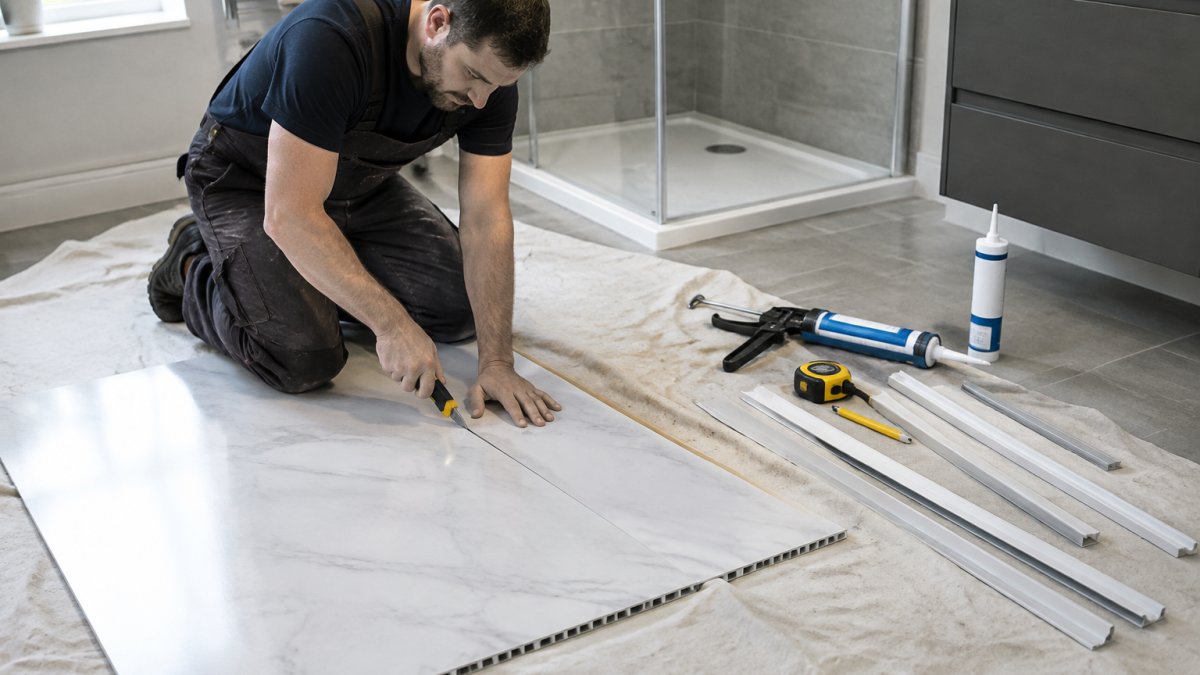
Watch out: do not rely on a generic "fire-rated" badge or a verbal assurance from a supplier. If the test report does not name the exact panel, thickness and finish being installed, treat the fire claim as unverified and specify a non-combustible finish at that junction instead.
PVC Panels Versus Tiles and Other Wall Coverings in a Fire
Tiles win on fire performance outright. Ceramic and porcelain are non-combustible, so they will not contribute fuel to a fire, which is a genuine advantage in kitchens and around heat sources. Where tiles lose is everything else: grout joints harbour mould, installation is slow and messy, and a cracked tile is a repair job.
PVC panels sit in the middle. They resist ignition, slow flame spread and outperform many organic wall coverings, while being waterproof and far quicker to fit. Glass splashbacks are non-combustible and easy to clean but costly and fragile. Painted plasterboard offers no meaningful protection in a wet area. Our comparison of bathroom wall panels versus tile sets out the full pros and cons. For most shower walls away from direct heat, PVC is the pragmatic choice; for the wall behind a hob, tile or glass is the safer one.
Choosing Fire-Safe Shower Panels for Your Project
Choosing well means matching the panel to the location, not chasing the highest rating on the box. For a standard shower enclosure, a PVC panel tested to BS EN 13501-1 with a Class 1 or Class B result is a sound specification. For commercial projects or rented property, check the reaction-to-fire classification against the building regulations that apply before you order.
Our range covers 250mm, 300mm, 500mm and 900mm panel widths, including Dumawall tile-effect and Linerio slatwall options. We also supply silicones, adhesives and trims for installation. Read our guide on why choose PVC shower wall panels, our roundup of the best waterproof wall panels for showers, and our step-by-step installation guide for fitting around heat sources safely.
| Situation | Recommended approach | Why it matters |
|---|---|---|
| Standard shower enclosure | PVC panel tested to BS EN 13501-1 | Resists ignition, waterproof, quick to fit |
| Wall behind a hob or stove | Tile, glass or non-combustible board | PVC is fire-retardant, not non-combustible |
| Commercial or rented property | Verify class against building regulations | Compliance is location-specific |
| Panel showing heat damage | Replace panel and check adhesive | Deformed PVC has lost performance |
| Tight ensuite | 250mm or 300mm panels | Fewer cuts, cleaner seams |
Frequently Asked Questions
Do PVC shower panels meet UK fire safety standards?
PVC wall panels may be tested to BS EN 13501-1, the European classification standard used in UK building regulations. Meeting a standard is not automatic across every product, though. Ratings are product-specific and can vary with panel thickness and construction, so ask the supplier for the actual test report for the panel you intend to fit rather than relying on a general claim.
Are PVC panels a fire hazard in bathrooms?
PVC contains chlorine, which gives it self-extinguishing properties: if a flame is removed, the material tends not to keep burning on its own. That does not make it fireproof. Under high-intensity, long-lasting fire it will eventually burn, and like any plastic it releases smoke. In a bathroom the realistic risks are limited, because the panels sit away from open flames. Keep them clear of hobs, heaters and downlights, and check the fire rating of the specific product against the requirements for the room.
Can I install PVC panels near a heat source?
Keep a sensible gap between panels and anything that produces sustained heat, such as a towel radiator, heater or hob, and follow the manufacturer's guidance on clearance. Bathroom panels are designed for steam and splashes, not direct heat. If a panel has been exposed to intense heat and shows warping, discolouration or bubbling, replace that section rather than covering it. When you install PVC wall panels, use the recommended adhesive and trims so the panel stays flat and sealed, which also keeps moisture out of the wall behind it.
What is a Class 1 fire rating for wall panels?
Class 1 refers to a classification for surface spread of flame, meaning the material performs well in a standard test of how quickly fire travels across its surface. It sits alongside BS EN 13501-1 classifications, which grade reaction to fire from A1 (non-combustible) down through B, C, D and so on. A Class 1 result is a good sign for a wall lining, but it describes one tested product, not every PVC panel on the market. Always match the rating to the room and confirm it with the supplier's documentation.
Fire safety is one part of a much bigger decision, and getting the panel, adhesive and trims right as a single system is what separates a bathroom that lasts from one that fails. Wetwall Wonders supplies tested PVC wall panels in a full range of widths alongside the silicones, adhesives and trims needed to complete the installation, so you can specify the whole job from one supplier. Get started with Wetwall Wonders and fit a shower wall system you can trust for years.


